
Quick version
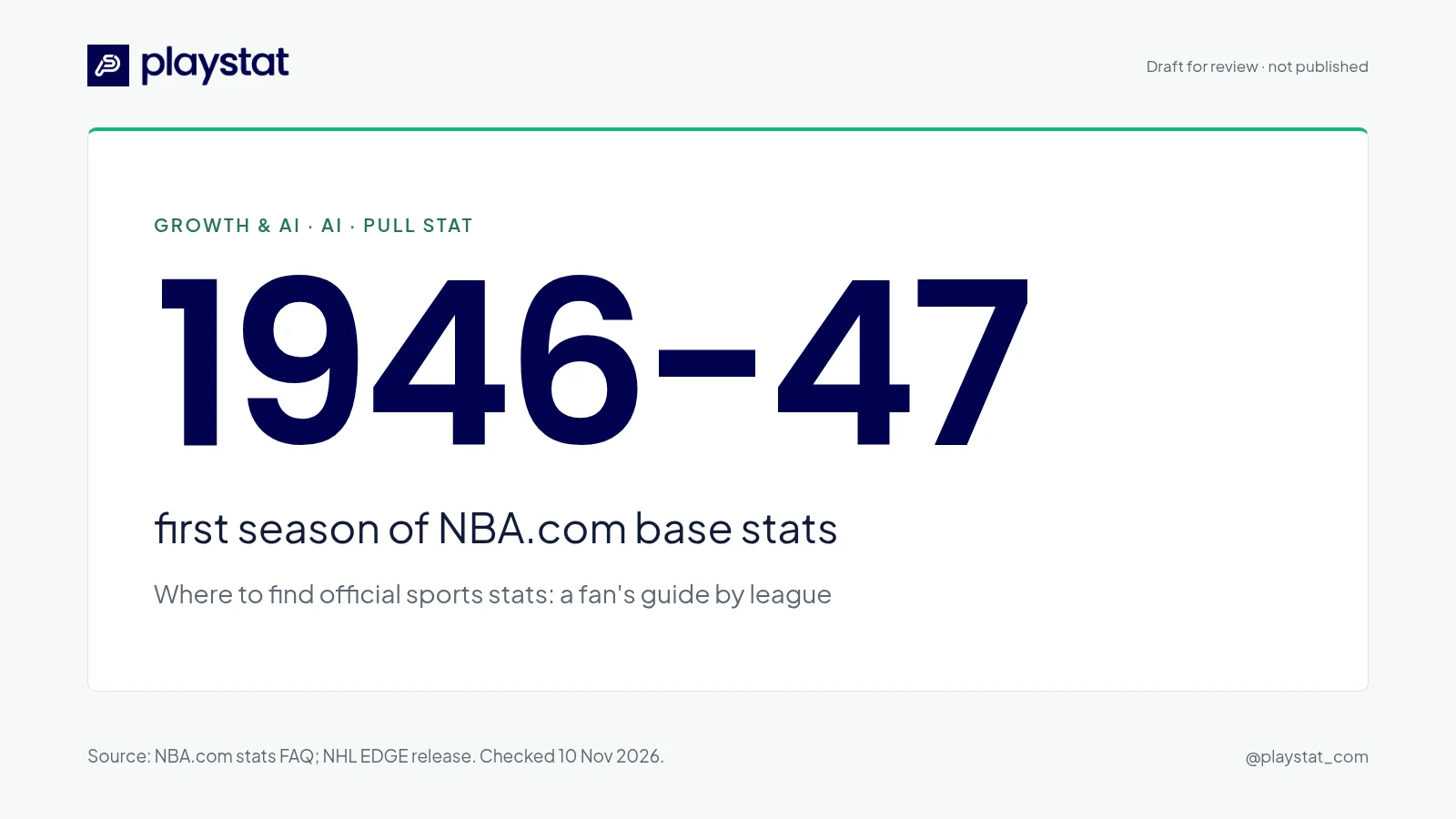
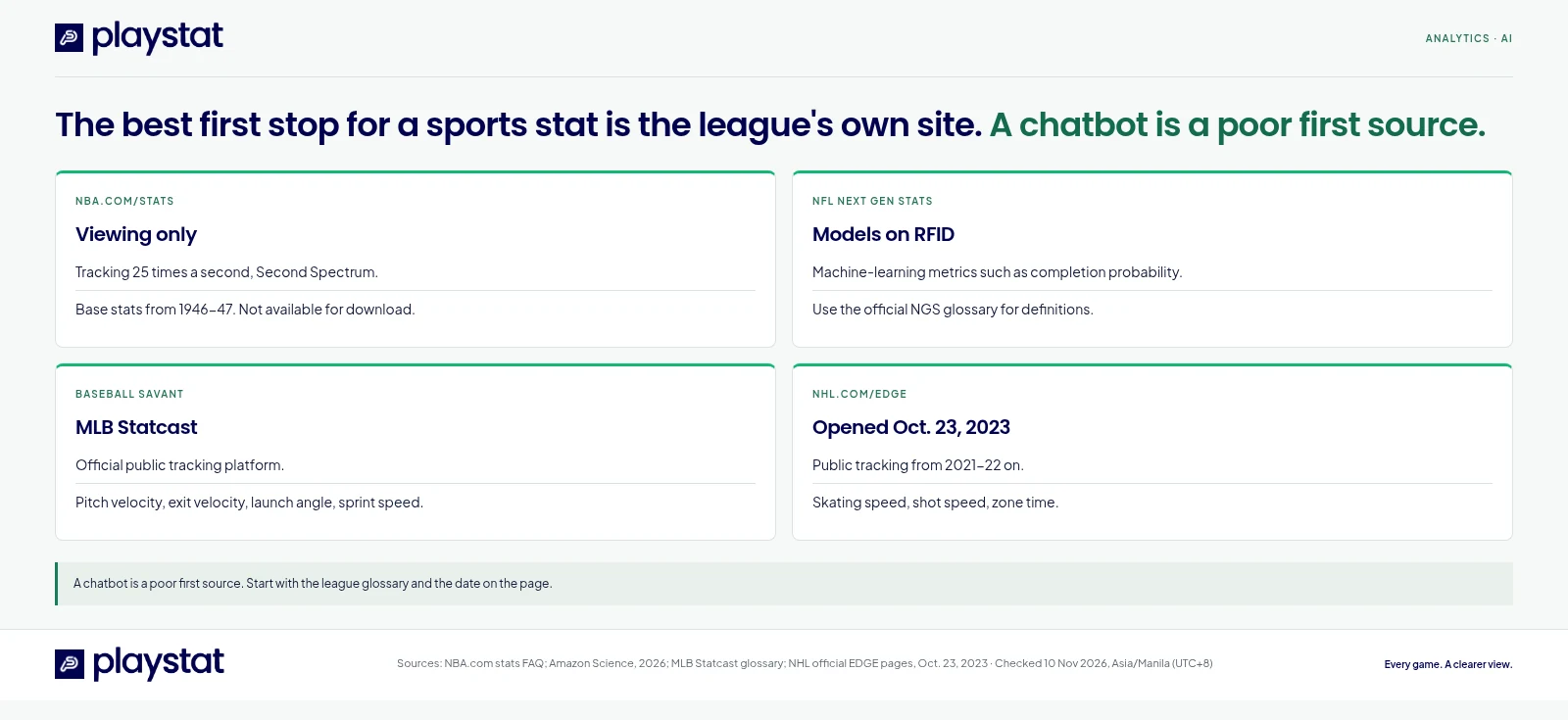
- NBA.com/stats publishes advanced and player-tracking statistics for viewing on the site.[1] Its FAQ says the stats are not available for download, that base stats go back to 1946-47, and that tracking uses Second Spectrum software and cameras, 25 times per second.
- NFL Next Gen Stats, described in a February 2026 Amazon Science article, turns RFID tracking into machine-learning metrics such as completion probability, with public explainers and a glossary on the league's NGS pages.[2]
- MLB publishes Statcast data for fans on Baseball Savant, the league's official public platform for tracking metrics such as pitch velocity, exit velocity, and launch angle, as described in MLB's Statcast glossary.
- The NHL launched NHL.com/EDGE on Oct. 23, 2023, giving fans public access to puck and player-tracking metrics from 2021-22 onward, including skating speed, shot speed, and zone time.[5]
Start with a definition, not a number
A tracking number without a definition is just typography. Official league sites now publish both: the figure, and a sentence about what was measured.
That is the useful starting point for a fan who wants to understand a game, not collect a pile of unexplained percentages. If the aim is to understand a stat, the league glossary is slower and better.
What the official pages actually give you
NBA.com/stats is the league's public stats site.[1] The FAQ says advanced stats go back to the 1996-97 season and base stats, including digitized box scores, go back to the inaugural 1946-47 season. Lineup data goes back to 2008. Player-tracking is explained in the same FAQ: cameras in the catwalks, Second Spectrum software, 25 times per second. The site also defines official metrics such as PIE and the "four factors" (effective field-goal percentage, turnover ratio, offensive rebound percentage, and free-throw attempt rate), with formulas.
The same FAQ is clear about a limit. The statistics are for viewing on NBA.com/Stats.[1] They are not available for download for academic or personal use.
The NFL's public tracking layer is Next Gen Stats. Amazon Science, in February 2026, describes how RFID coordinates are turned into models, including completion probability, which estimates the difficulty of a throw from inputs such as pressure, throw depth, receiver separation, and sideline proximity.[2] The league also maintains a Next Gen Stats glossary at nextgenstats.nfl.com.[3] Use that glossary when a broadcast flashes a probability. The number is a model output, not a box-score tally.
MLB's tracking product is Statcast, published for fans through Baseball Savant at baseballsavant.mlb.com. MLB's official Statcast glossary describes the system as measuring and analyzing data from every Major League game, including pitch, hit, and player tracking, with public metrics such as pitch velocity, spin rate, exit velocity, launch angle, and sprint speed. If you want to know how hard a ball was hit, that is the official place to look it up.
The NHL opened a fan-facing tracking site later than the others. An official NHL release dated Oct. 23, 2023, announced NHL.com/EDGE, developed with Sportradar, with leaderboards and comparison tools for skating speed, skating distance, shot speed, shot location, and puck zone time, searchable from the 2021-22 season through regular-season and playoff games.[5] A same-day NHL.com explainer said puck and player tracking became fully operational in 2021-22, with infrared emitters in each puck and sweater.[5] That explainer said cameras detect puck signals up to 60 times per second and player signals up to 15 times per second. The official release described 14 IR cameras above the ice and said the system can generate nearly one million three-dimensional coordinates and data points over a regulation game, with machine-learning models forming the basis of the EDGE stats.
How to read a model without getting ahead of it
Completion probability, rush yards over expected, and similar metrics are estimates built on tracking data. They can tell you that a completed pass was a hard one, or that a run gained more than a typical carry would in that traffic. They cannot, on their own, tell you what will happen next Sunday.
A second habit helps. When two sites disagree, prefer the league definition and the date on the page. NBA.com warns that official leaderboards have qualification rules.[1] EDGE refreshes overnight, the 2023 explainer said, because of the complexity of the calculations. A number copied into a social post may be from a different filter, a different season, or a different qualifying rule.
Try this
Pick one stat you have seen on a broadcast this week. Open the official glossary or FAQ for that league and read the definition before you argue about the number. If you cannot find the definition on the league site, do not treat the number as official. And if a chatbot gives you a tidy answer with no link, go and look it up anyway.
The money side
The official fan sites reviewed here are free to view. NBA.com's FAQ states that the league's stats are not available for download.[1] League Pass and other paid broadcast products, mentioned in the NBA's 2023 Second Spectrum release as a place where tracking graphics can appear, are separate from the free stats pages.
References
Numbered markers in the text, such as [1], link to the source below. All links accessed 10 Nov 2026.
- FAQ | Stats | NBA.com. nba.com/stats/help/faq. Accessed 10 Nov 2026.Used for: advanced stats from 1996-97; base stats from 1946-47; tracking 25 times per second; stats not available for download; PIE and four factors
- A decade of NFL Next Gen Stats innovation. Amazon Science. amazon.science/blog/a-decade-of-nfl-next-gen-stats-innovation. Accessed 10 Nov 2026.Used for: RFID tracking; completion probability and other machine-learning metrics
- NFL Next Gen Stats glossary. nextgenstats.nfl.com/glossary. Accessed 10 Nov 2026.
- Statcast | Glossary | MLB.com. mlb.com/glossary/statcast. Accessed 10 Nov 2026.Used for: Statcast as MLB's tracking system; public metrics including pitch velocity, spin rate, exit velocity, launch angle, sprint speed
- NHL EDGE website provides Puck and Player Tracking data to fans. NHL.com. nhl.com/news/topic/nhl-edge/nhl-edge-launches-website-for-puck-a…. Accessed 10 Nov 2026.Used for: site launch; 2021-22 operational; up to 60 times per second for the puck and 15 for players; metrics and overnight refresh
- NHL EDGE advanced stats section brings fans closer to game. official NHL release, Oct. 23, 2023. NHL.com. nhl.com/news/nhl-edge-advanced-stats-section-brings-fans-closer-…. Accessed 10 Nov 2026.Used for: NHL.com/EDGE; 14 IR cameras in the release wording; nearly one million data points per regulation game; machine-learning models; data since 2021-22