


Quick version
- Ericsson, Krampe, and Tesch-Römer, in Psychological Review in 1993, argued that expert performance is the result of prolonged, effortful practice designed to improve, extended for a minimum of 10 years, and that many traits once treated as innate talent are a product of that work.[1]
- BBC News, in 2014, reported that the elite violinists in that research had averaged more than 10,000 hours of practice by age 20, compared with 4,000 hours in a less accomplished group, and that Gladwell's Outliers introduced "the 10,000-hour rule" to a mass audience.[2]
- The same BBC report quotes Ericsson's 2012 rebuttal: the 10,000-hour rule was Gladwell's phrasing, 10,000 was an average, and some of the best musicians in the study had accumulated substantially fewer hours.[2] Ericsson also wrote that Gladwell did not mention deliberate practice itself.[5]
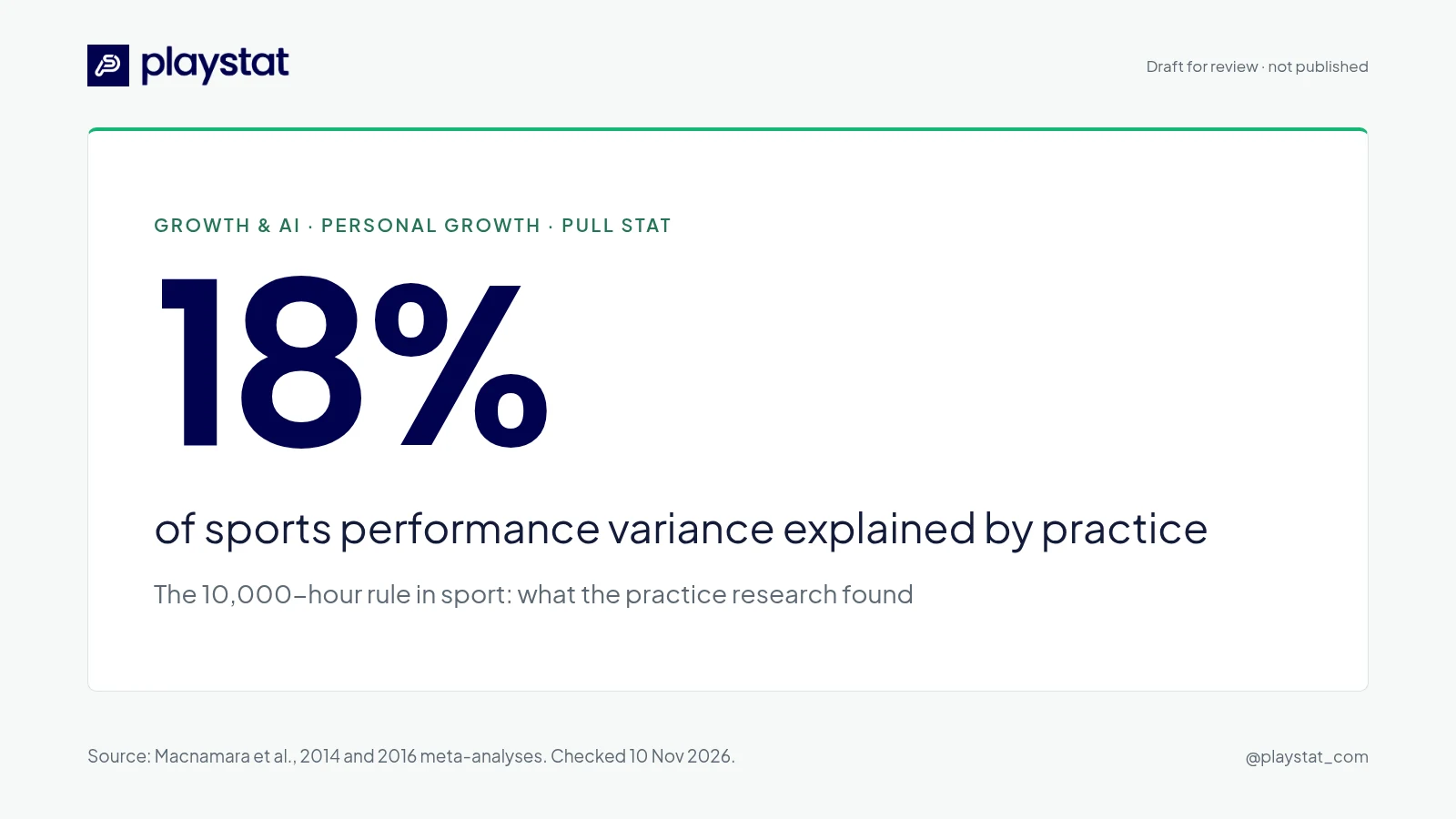
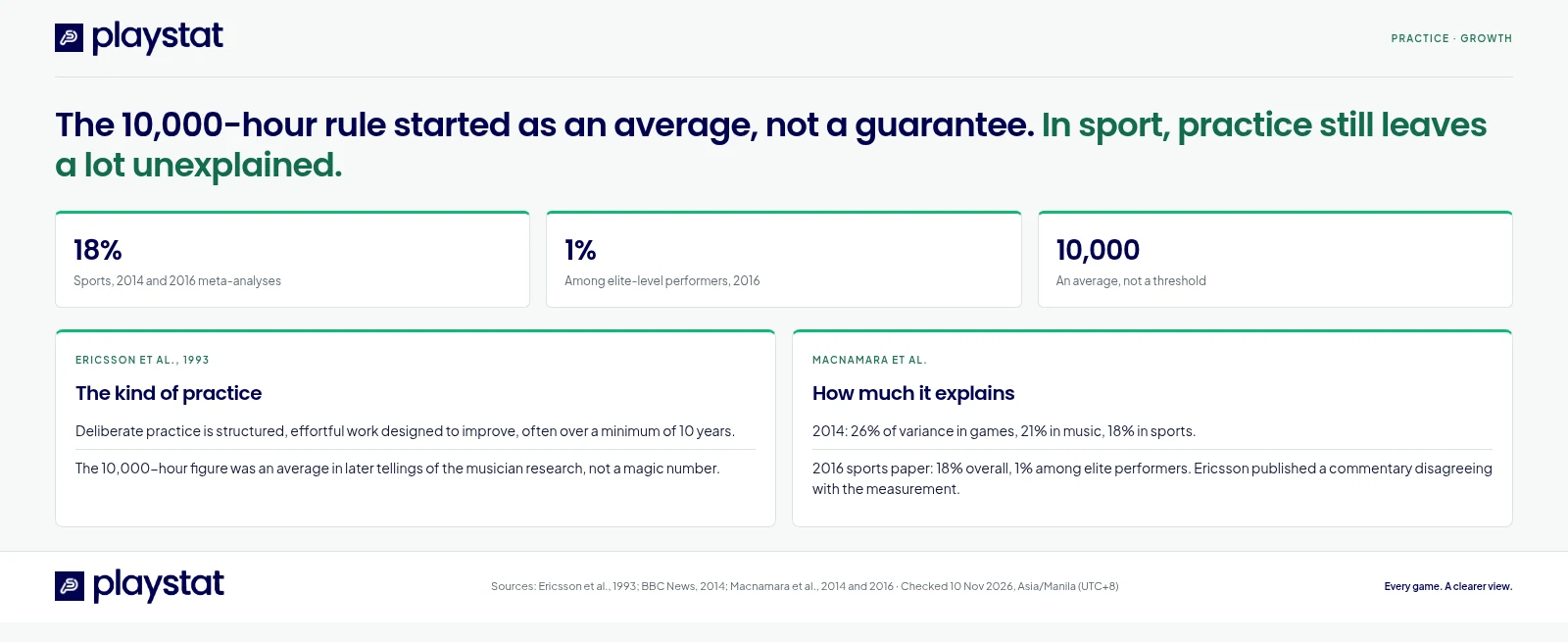
- A 2014 meta-analysis by Macnamara, Hambrick, and Oswald, in Psychological Science, found that deliberate practice explained 18% of the variance in performance in sports, 21% in music, and 26% in games.[3] A 2016 sports-only meta-analysis by Macnamara, Moreau, and Hambrick found the same 18% overall, and only 1% among elite-level performers.[5]
What Ericsson actually studied
The useful idea in the 1993 paper is not a round number. It is a kind of practice.
Deliberate practice, in that framework, is not playing the game for fun, and it is not repeating what you already do well. It is structured work, designed to improve a specific skill, done with attention and, typically, feedback. It is effortful enough that even experts can only do so much of it in a day. The paper's abstract says expert performance is the end result of prolonged efforts to improve, and that, in most domains, people begin in childhood a regimen of those activities. It also says many characteristics once believed to reflect innate talent are actually the result of intense practice extended for a minimum of 10 years.
The 10,000-hour figure comes out of the same research tradition, as an average for the most accomplished group of young violinists by about age 20. It was not, in Ericsson's later wording, a magic threshold that every expert had crossed.[1]
How a rule got loose
Malcolm Gladwell's 2008 book Outliers is, in the BBC's 2014 account, largely responsible for introducing "the 10,000-hour rule" to a mass audience.[2] The BBC quotes Ericsson's 2012 rebuttal paper, "The Danger of Delegating Education to Journalists," in which he wrote that Gladwell had stated researchers had settled on 10,000 hours as "the magic number for true expertise," and that Gladwell had cited the musician research as a stimulus for a "provocative generalisation."[2]
Ericsson's objections, as quoted there, were specific.[5] Ten thousand was an average. Many of the best musicians in the study had accumulated substantially fewer hours. And quality mattered: Ericsson wrote that Gladwell did not even mention the concept of deliberate practice.[5]
Hours are not the same as practice. Playing 10,000 hours of pickup basketball is not the same work as a decade of designed, feedback-heavy training. And even designed practice is not a promise.
What the sports research found later
If practice alone made the expert, you would expect accumulated deliberate practice to explain most of the difference between athletes. The later meta-analyses do not show that.
Macnamara, Hambrick, and Oswald, in Psychological Science in 2014, combined studies across games, music, sports, education, and professions.[3] They found that deliberate practice explained 26% of the variance in performance for games, 21% for music, 18% for sports, 4% for education, and less than 1% for professions. Their conclusion was plain: deliberate practice is important, but not as important as has been argued.
Macnamara, Moreau, and Hambrick followed that with a sports-focused meta-analysis in Perspectives on Psychological Science in 2016.[5] Overall, deliberate practice again accounted for 18% of the variance in sports performance. Among elite-level performers, it accounted for only 1%. The same paper also found that athletes who reached a high skill level had not, on average, begun their sport earlier in childhood than lower-skill athletes.
Ericsson published a commentary in the same issue, arguing about how practice had been defined and measured.[5] It reports both the meta-analytic figures and the fact that Ericsson disputed the interpretation.[5]
The practical reading is still fairly stable. Practice of the designed kind is part of how people get good. It does not, by itself, explain why one elite athlete beats another. Starting earlier is not, in that 2016 analysis, the clean advantage it is often assumed to be.
Try this
If you want the research, not the slogan, change the question. Do not ask whether you have reached 10,000 hours. Ask whether the next hour has a specific target, a way to see if you improved, and a stop before the work turns sloppy. That is closer to what Ericsson described.[5] And if you are already competing at a high level, do not expect more volume alone to be what separates you from the rest of the field. The 2016 sports analysis found almost no relationship there.
References
Numbered markers in the text, such as [1], link to the source below. All links accessed 10 Nov 2026.
- The role of deliberate practice in the acquisition of expert performance. doi.org/10.1037//0033-295x.100.3.363. Accessed 10 Nov 2026.Used for: prolonged deliberate practice; minimum of 10 years; abstract
- Can 10,000 hours of practice make you an expert?. BBC. bbc.com/news/magazine-26384712. Accessed 10 Nov 2026.Used for: elite violinists averaging more than 10,000 hours by age 20 vs 4,000; Gladwell's Outliers; Ericsson 2012 rebuttal quoted, including that 10,000 was an average and that Gladwell did not mention deliberate practice
- Deliberate Practice and Performance in Music, Games, Sports, Education, and Professions: A Meta-Analysis. doi.org/10.1177/0956797614535810. Accessed 10 Nov 2026.Used for: 26% games, 21% music, 18% sports, 4% education, less than 1% professions
- The Relationship Between Deliberate Practice and Performance in Sports: A Meta-Analysis. pubmed.ncbi.nlm.nih.gov/27217246/. Accessed 10 Nov 2026.Used for: 18% overall in sports; 1% among elite performers; starting age finding
- Ericsson, K. A., commentary on Macnamara, Moreau, and Hambrick (2016), Perspectives on Psychological Science, 2016, 11(3), 351-354. pubmed.ncbi.nlm.nih.gov/27217247/. Accessed 10 Nov 2026.Used for: Ericsson's published disagreement on how practice was identified