
Quick version
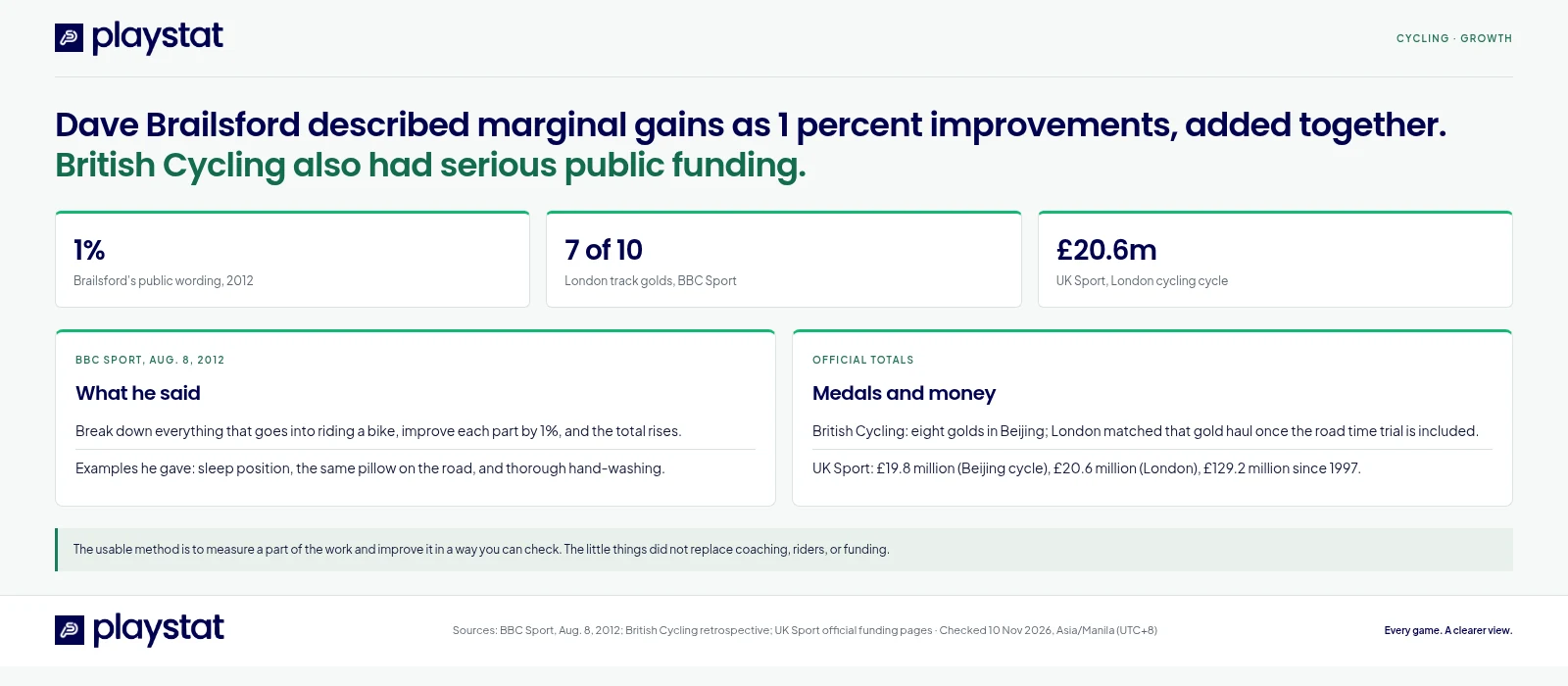
- On Aug. 8, 2012, BBC Sport quoted British Cycling performance director Dave Brailsford on BBC Breakfast: if you broke down everything that goes into riding a bike, and improved each part by 1%, you would get a significant increase when you put them all together.[1] He gave examples including sleep position, traveling with the same pillow, and cleaning hands thoroughly to reduce illness.
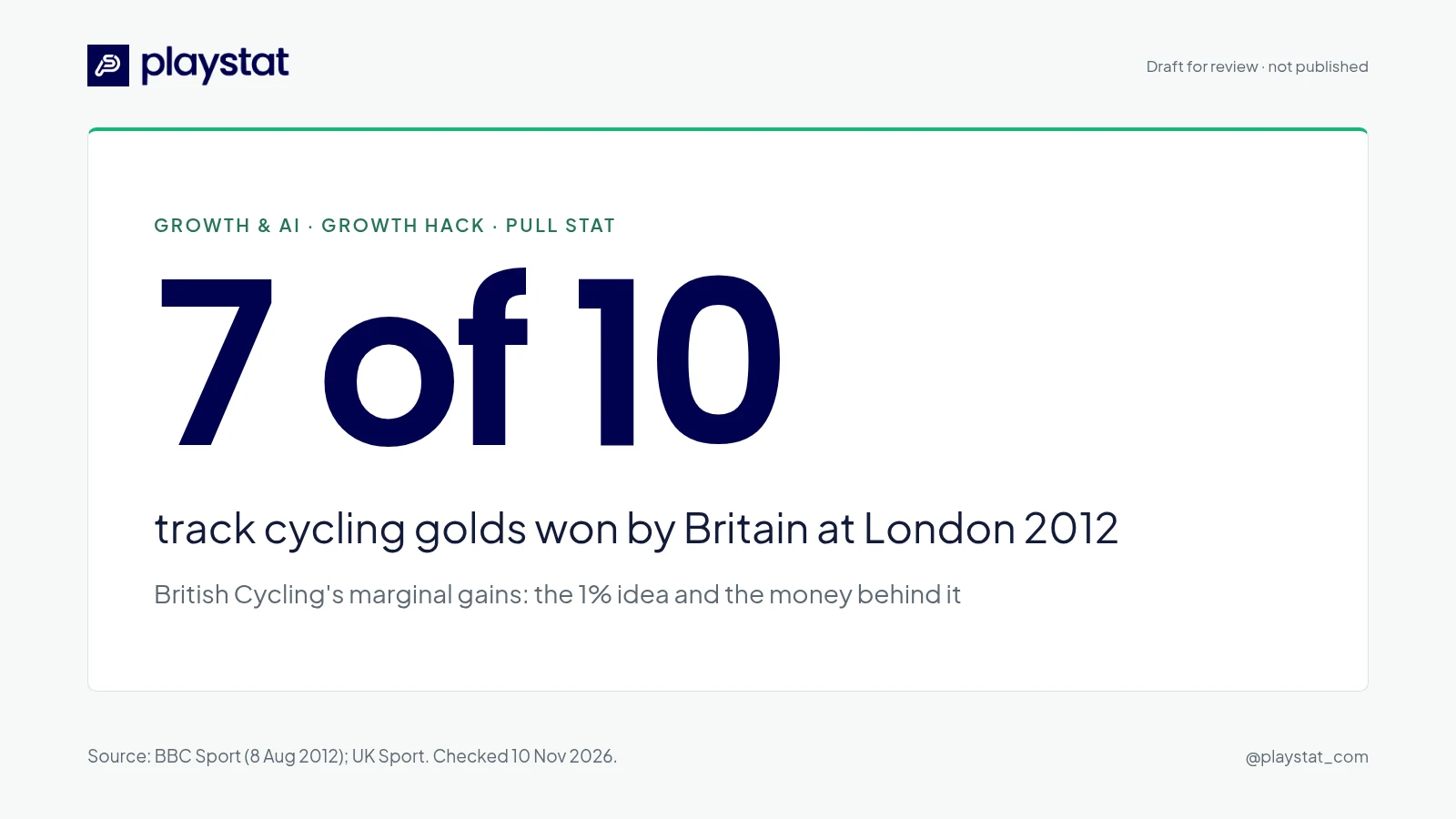
- The same BBC report said Britain had won seven of 10 track cycling gold medals in London, matching the track haul from Beijing 2008.[1]
- British Cycling's official retrospective of the Brailsford years says that, before Athens 2004, British Olympic cycling golds had been scarce; that Athens brought golds for Chris Hoy and Bradley Wiggins; that the Beijing 2008 team won eight gold medals; and that London 2012 brought seven golds on the track, plus Wiggins's road time-trial gold, equalling the Beijing gold haul.[2]
- UK Sport's official cycling page lists National Lottery-era funding of £19,785,347 for the Beijing cycle and £20,613,900 for London, and a total of £129,154,051 since funding began in 1997.[3]
What Brailsford actually said
The phrase "marginal gains" gets used now for almost any small improvement at work. The documented version, from London 2012, is narrower.
BBC Sport's Matt Slater, writing from the London Velodrome on Aug. 8, 2012, quoted Brailsford after Britain had taken seven of the 10 track golds.[1] The whole principle, Brailsford said, "came from the idea that if you broke down everything you could think of that goes into riding a bike, and then improved it by 1%, you will get a significant increase when you put them all together." He mentioned fitness and conditioning, then "other things that might seem on the periphery," including sleeping in the right position, having the same pillow when away, and knowing how to clean your hands, "without leaving the bits between your fingers," so that riders would "get ill a little bit less."
British Cycling later used the same 1% wording in its official retrospective when Brailsford stepped down as performance director. In that telling, the approach was already being applied around Athens 2004, when Hoy won the kilometre time-trial and Wiggins won the individual pursuit. Beijing, the same official history says, brought eight gold medals. London brought seven golds on the track, and Wiggins added the road time trial, matching the Beijing gold total. The retrospective also notes Wiggins's 2012 Tour de France win with Team Sky, two years earlier than a target Brailsford had set of winning the Tour by 2014.
Those are official and contemporaneous accounts of the idea, and of the results the governing body and the BBC attached to that period.[1] They are not a complete theory of why the medals came.
What the folklore adds, and what it leaves out
After London, the pillow and the hand-washing became the whole story in a lot of retellings. The BBC piece itself pushed back, in tone if not in a footnote.[1] Opponents wanted a simpler explanation, it said, and Brailsford's athletes talked about the work: hours in wind tunnels, skin suits, selection calls, and a psychologist, Steve Peters, whom Brailsford had brought in. Hoy, in that report, trained 35 hours a week.
The point is simpler. "Tiny things, clumped together" was Brailsford's own public description. It was never a claim that funding, coaching, equipment research, and riders who could do the work were optional.
UK Sport's official figures make the money visible.[4] For Olympic cycling, the agency lists £19,785,347 in the Beijing cycle and £20,613,900 in the London cycle. The cycling page also gives a total of £129,154,051 in historical funding since National Lottery funding began in 1997.
The BBC report also noted that British Cycling had bought into a "medals mean money" funding model.[1] That is the reporter's characterization. The official UK Sport tables are the figures used here.[4]
A method, not a myth, and not the whole truth
There is a usable idea in the 1% framing, if you keep it honest. Break a job into parts you can actually measure. Improve a part in a way you can check. Add the improvements only when they are real. Do not confuse a travel pillow with a training program, and do not treat a slogan as proof.
Those questions are not settled here, and they are a reason not to tell the London story as a clean fable about attention to detail. The sourced claim is narrower: this is what Brailsford said the method was, this is what the official medal account of that period shows, and this is what the public funding tables show.
Try this
If you want to borrow the method, borrow the boring version. Write down the actual parts of a goal you can measure this month. Improve one of them by a small, checkable amount. Leave the folklore out. And if someone tells you that success was "just the little things," ask what the big things were too: time, coaching, and money.
The money side
UK Sport's official cycling page lists £19,785,347 for the Beijing Olympic cycle and £20,613,900 for London, and a total of £129,154,051 in National Lottery-era funding since 1997.[3] A later Paris-cycle figure differs slightly between UK Sport's cycling page and its historical-funding table, so that later figure is not used here.[4] These are sport-wide investment totals, in the pounds of the funding cycle, with no inflation adjustment.
References
Numbered markers in the text, such as [1], link to the source below. All links accessed 10 Nov 2026.
- Olympics cycling: Marginal gains underpin Team GB dominance. BBC. bbc.com/sport/olympics/19174302. Accessed 10 Nov 2026.Used for: Brailsford 1% quotation; pillow and hand-hygiene examples; seven of 10 track golds in London, matching Beijing's track haul
- Sir Dave Brailsford at British Cycling - A career retrospective. britishcycling.org.uk/gbcyclingteam/article/gbr20140411-British-…. Accessed 10 Nov 2026.Used for: Athens golds for Hoy and Wiggins; eight golds in Beijing; seven track golds in London plus Wiggins's road time trial; Team Sky and the 2012 Tour; the same 1% wording
- Cycling. UK Sport. uksport.gov.uk/sports/olympic/cycling. Accessed 10 Nov 2026.Used for: Beijing £19,785,347; London £20,613,900; total historical funding since 1997 of £129,154,051
- Historical funding figures. UK Sport. uksport.gov.uk/our-work/investing-in-sport/historical-funding-fi…. Accessed 10 Nov 2026.Used for: London cycling figure £20,613,900, consistent with the cycling page; tables updated April 2025