

Quick version
- Liberty Media completed its acquisition of Formula 1 on Jan. 23, 2017.[1] The official release said the transaction represented an enterprise value of $8.0 billion and an equity value of $4.4 billion. The same release said F1 was watched by 400 million unique television viewers from over 200 territories in 2016.
- Drive to Survive launched in 2019. An official F1.com feature dated March 9, 2025, said that after Season 7 there would be 70 episodes available, stretching back to 2019, and that Season 5 recorded more than 90 million viewing hours in its first few months, according to Netflix viewing data.[5]
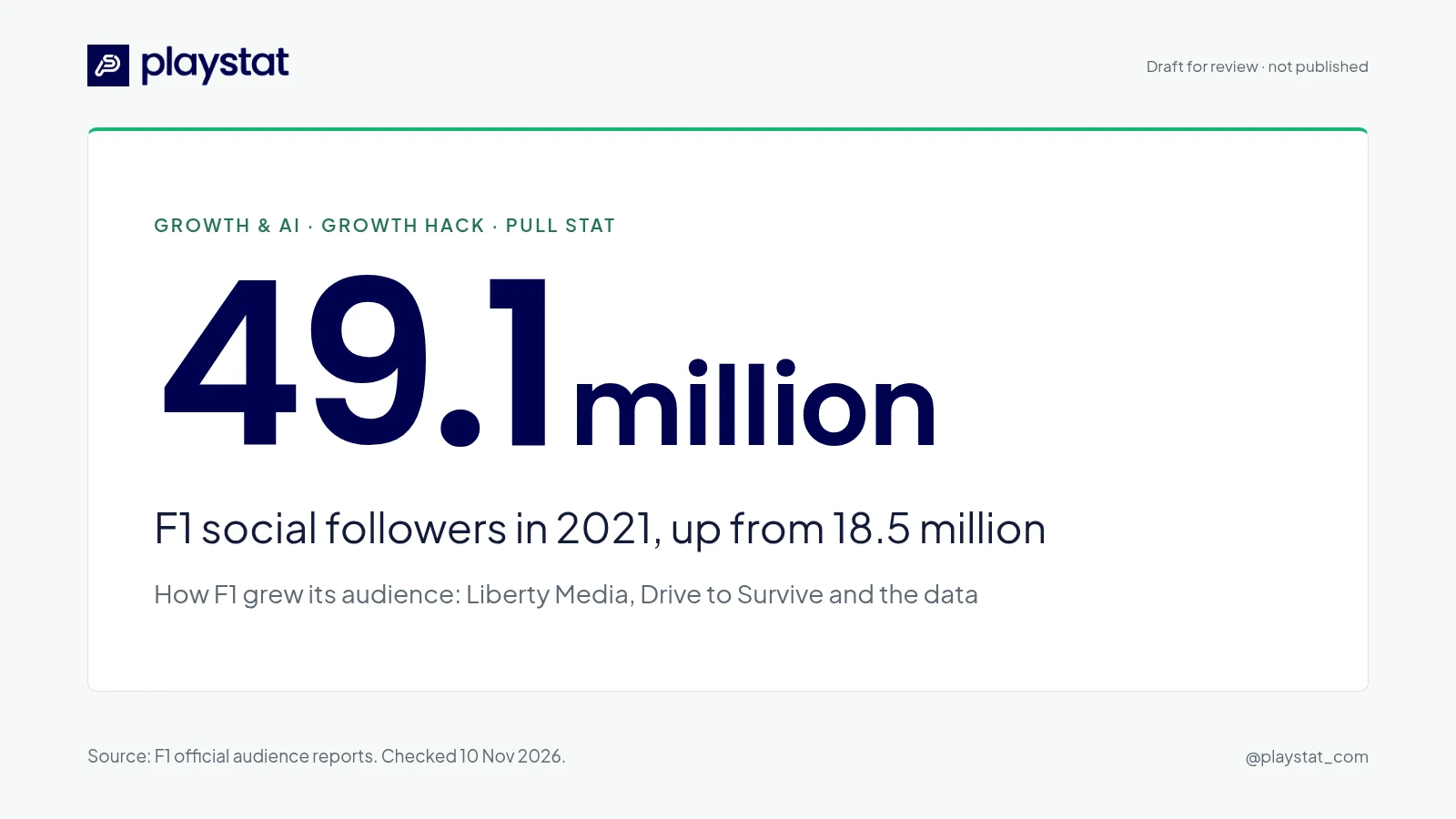
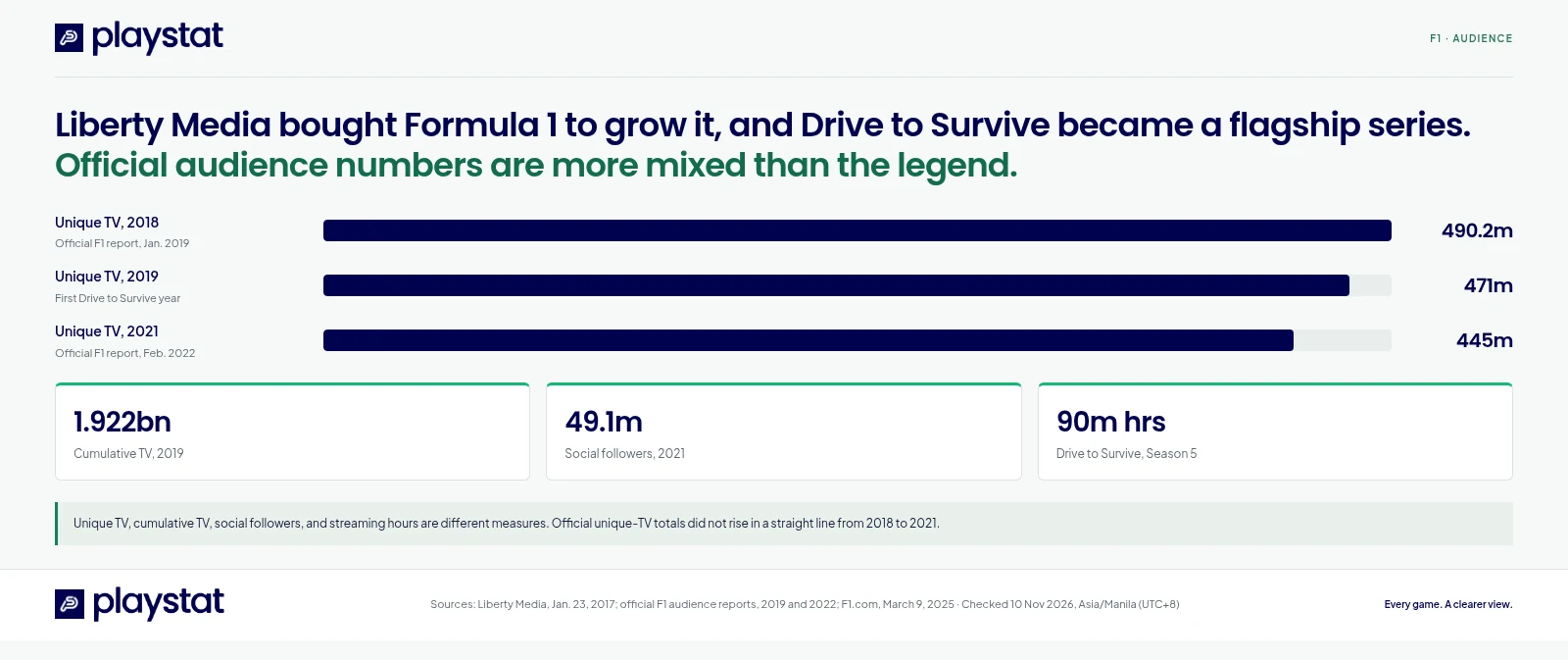
- Official F1 audience reports show a cumulative global TV audience of 1.758 billion in 2018 and 1.922 billion in 2019, the first Drive to Survive year. Unique viewers were 490.2 million in 2018 and 471 million in 2019. In 2021, the cumulative TV audience was 1.55 billion and unique viewers were 445 million.
- Digital and social growth was steeper in those official reports. Social followers rose from 18.5 million in 2018 to 24.9 million in 2019 and 49.1 million in 2021, across a widening set of platforms.
A purchase with a growth brief
When Liberty Media closed the Formula 1 deal on Jan. 23, 2017, the official release was not shy about intent.[1] Greg Maffei, Liberty's president and CEO, said there was "an enormous opportunity to grow the sport." The consideration, the release said, included $3.05 billion in cash, newly issued shares, and an exchangeable debt instrument, for an enterprise value of $8.0 billion and an equity value of $4.4 billion.
The same release gave a 2016 baseline: 400 million unique television viewers from over 200 territories, and a 21-race calendar. Those are Liberty's official figures from the closing announcement, in 2017 dollars, with no later inflation adjustment.
The series that became the shorthand
Drive to Survive, made with Box to Box and released on Netflix, is the thing most later stories credit for a new audience. The official F1.com "in numbers" feature for Season 7, published March 9, 2025, is careful in a useful way.[5] It is mostly a production ledger: crews at every Grand Prix, almost 10,000 hours of footage over seven years, 160 people on each season, availability in more than 190 countries. It also gives one big viewing figure. Season 5, it says, recorded more than 90 million viewing hours in its first few months, according to Netflix's viewing data report.
The same feature says that after Season 7 there would be 70 episodes available, stretching back to 2019. That dates the series, officially, to the year after Liberty's first full season of ownership had already been in the books.
It is a documented content bet: a behind-the-scenes series, in 190-plus countries, with a Season 5 viewing-hours figure F1 was willing to put on its own site.
What the official TV numbers actually show
The clean version of the legend is that Drive to Survive sent global TV audiences sharply up. The official reports are messier, and they are worth reading as they were published.
In January 2019, F1 said the 2018 season had reached 490.2 million unique TV viewers, up 10% globally, with a cumulative global audience of 1.758 billion. That season ended before Drive to Survive launched.
In January 2020, F1 said the 2019 season, the first with the series, had a cumulative global TV audience of 1.922 billion, up 9% and the highest since 2012. Unique viewers, though, fell slightly, to 471 million, down 3.9% globally, and were described as stable in the top 20 markets at 405.5 million. The same report said 62% of new fans accumulated in the previous two years, in 27 markets monitored by Nielsen, were under 35, and it listed a U.S. fan count of 34.6 million in that Nielsen set.
In February 2022, F1 said the 2021 cumulative TV audience was 1.55 billion, up 4% from 2020, and unique viewers were 445 million, up 3% from 2020. The report is explicit about broadcast-deal changes, including lower numbers in Brazil and Germany under new arrangements, and it gives a like-for-like average-audience comparison that excludes those markets. It also reports a 58% year-on-year rise in U.S. cumulative audience and a 53% rise in U.S. unique viewers, and it says some 2021 attendances in the United States, Mexico, and Great Britain were higher than in 2019.
Those official unique-TV totals, lined up, do not form a straight upward ramp from 2018 through 2021. Cumulative figures moved around as well, and 2020-21 cannot be read without the pandemic and shifting broadcast contracts.
Where the growth is clearer
The same official reports are much less mixed on digital and social. Followers across F1's counted platforms went from 18.5 million in 2018 to 24.9 million in 2019, with the 2019 report calling F1 the fastest-growing major sports league on social media. By 2021, F1 reported 49.1 million followers across a longer list of platforms, including TikTok, Snapchat, Twitch, and Chinese sites, with 7 billion video views.
That is still not a single cause. Liberty's brief, a documentary series, a busier digital operation, and the 2021 title fight all sit in the same window. The honest growth lesson is a bit drier than the usual one. A new audience can show up first in the places you can actually measure: followers, video views, some national TV markets, and a streaming series with a published viewing-hours figure. It may not show up, in the same years, as a simple rise in unique global TV viewers.
Try this
If you are looking at a "this show saved the sport" story, pull the official numbers and split them. Unique TV, cumulative TV, social followers, and streaming hours are different measures. F1 published all of them. Use the one that matches the claim, and keep the years attached. The Season 5 figure of more than 90 million viewing hours is a series statistic, not a substitute for the annual TV report.
The money side
Liberty Media's Jan. 23, 2017, release valued the Formula 1 transaction at an $8.0 billion enterprise value and a $4.4 billion equity value, including $3.05 billion in cash plus shares and an exchangeable instrument.[1] Those are 2017 transaction figures, not a later market cap, and they are not inflation-adjusted.
References
Numbered markers in the text, such as [1], link to the source below. All links accessed 10 Nov 2026.
- Liberty Media Corporation Completes Acquisition of Formula 1. libertymedia.com/investors/news-events/press-releases/detail/305…. Accessed 10 Nov 2026.Used for: $8.0 billion enterprise value; $4.4 billion equity value; $3.05 billion cash; 400 million unique TV viewers in 2016
- F1 broadcast to 1.9 billion total audience in 2019. Formula1.com, Jan. 21, 2020. Formula 1. formula1.com/en/latest/article/f1-broadcast-to-1-9-billion-fans-…. Accessed 10 Nov 2026.Used for: 1.922 billion cumulative; 471 million unique viewers; social and digital figures; Nielsen fan-base notes
- Formula 1 TV and digital audience grow for the second year running. Formula One World Championship Limited, Jan. 18, 2019. corp.formula1.com/formula-1-tv-and-digital-audience-grow-for-the…. Accessed 10 Nov 2026.Used for: 2018: 490.2 million unique viewers; 1.758 billion cumulative; 18.5 million social followers
- Formula 1 announces TV, race attendance and digital audience figures for 2021. Formula1.com, Feb. 17, 2022. formula1.com/en/latest/article/formula-1-announces-tv-race-atten…. Accessed 10 Nov 2026.Used for: 1.55 billion cumulative; 445 million unique viewers; 49.1 million followers; U.S. year-on-year rises; attendance notes
- IN NUMBERS: The incredible figures behind seven seasons of Drive to Survive. Formula1.com, March 9, 2025. Formula 1. formula1.com/en/latest/article/in-numbers-the-incredible-figures…. Accessed 10 Nov 2026.Used for: series from 2019; 70 episodes after Season 7; Season 5 more than 90 million viewing hours; production facts