
Quick version
- Mah, Mah, Kezirian, and Dement published "The Effects of Sleep Extension on the Athletic Performance of Collegiate Basketball Players" in SLEEP in July 2011.[1] Eleven Stanford men's basketball players kept their usual sleep for 2-4 weeks, then aimed for a minimum of 10 hours in bed for 5-7 weeks.
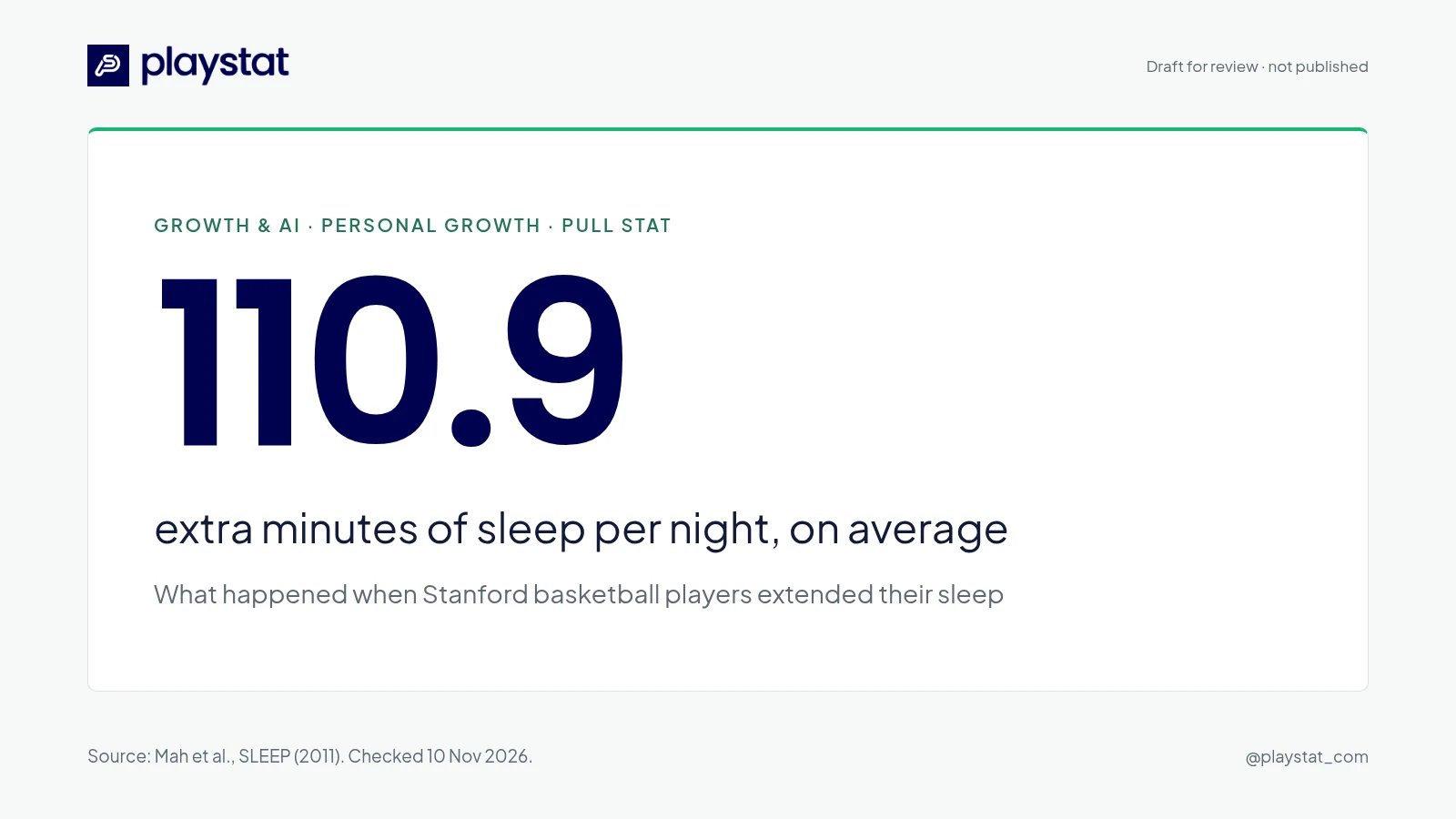
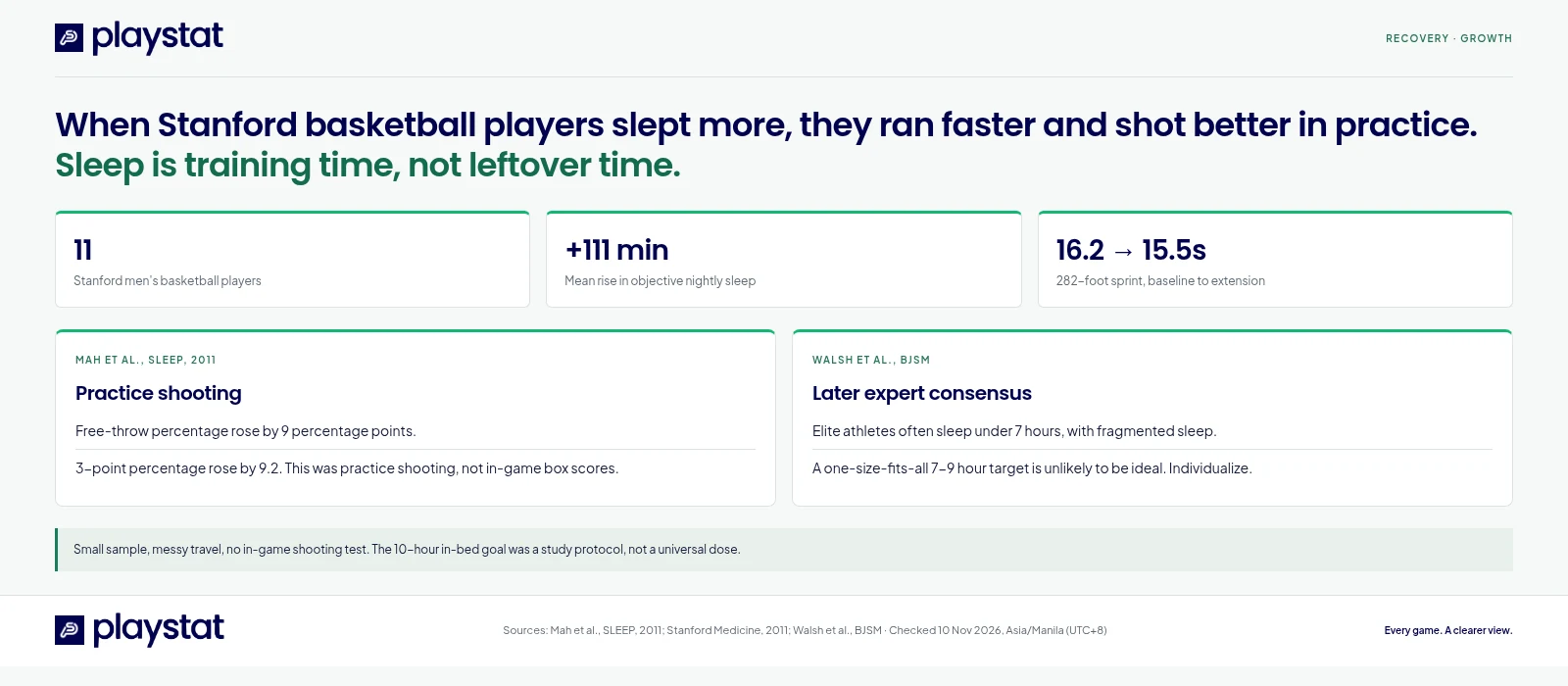
- Objective nightly sleep rose by 110.9 minutes on average. A timed 282-foot sprint improved from 16.2 seconds at baseline to 15.5 seconds. Free-throw percentage rose by 9 percentage points, and 3-point percentage by 9.2, in practice shooting.
- Stanford Medicine's news account of the study noted the limits: a small sample, travel that made a strict schedule hard, and no focus on in-game shooting.[3]
- Walsh and colleagues, in a 2021 expert consensus in the British Journal of Sports Medicine, wrote that elite athletes are particularly susceptible to short and fragmented sleep, that a night or more without sleep reduces performance, and that a one-size-fits-all 7-9 hour recommendation is unlikely to be ideal.[4]
A small study with a clear setup
Cheri Mah and colleagues did not tell the Stanford players to "get a good night's sleep" before a game.[1] They tried something more specific: measure a baseline, then extend sleep for several weeks and measure again.
The paper, in SLEEP in 2011, describes 11 healthy students on the Stanford men's varsity team, with a mean age of 19.4.[2] After a 2-4 week baseline of their usual sleep, with a reported nightly window of 6-9 hours of subjective sleep, they spent 5-7 weeks getting as much nocturnal sleep as possible, with a minimum goal of 10 hours in bed. Stanford Medicine's summary says players avoided coffee and alcohol during the study period, and were asked to nap when travel kept them from reaching 10 hours at night.[3]
The results, as published, were not subtle in the practice tests. Total objective nightly sleep increased by 110.9 minutes, plus or minus 79.7. The timed sprint, 282 feet, went from 16.2 seconds to 15.5. Free-throw percentage increased by 9 percentage points, and 3-point percentage by 9.2. Reaction time and sleepiness scores improved, and mood scores showed more vigor and less fatigue.
That is the study. It is also a study of 11 players, during a college season, with practice shooting as the accuracy test. The authors and the Stanford news office both flagged those limits. The findings were not in-game box scores. They should not be turned into a promise that 10 hours in bed will add 9 percentage points to anyone's shooting in a game.
Mah, in the Stanford account, said competitive athletes often treat sleep as the first thing to sacrifice, even when they already know rest matters.[1] The surprising part of the baseline, she said, was how much daytime sleepiness the players were already carrying during the season.
What later guidance added
Sleep-loss research points in the same general direction, from the other side. Fullagar, Skorski, and colleagues reviewed the effects of sleep loss on exercise performance, and on physiological and cognitive responses to exercise, in Sports Medicine in 2015.[5] The title is the scope: sleep loss is not free.
In 2020-21, Walsh, Halson, Sargent, and a large group of colleagues published a narrative review and expert consensus in the British Journal of Sports Medicine.[4] The abstract is careful. Elite athletes, they wrote, are particularly susceptible to sleep inadequacies, characterized by habitual short sleep (under 7 hours a night) and poor sleep quality, including fragmentation. Athletic performance is reduced by a night or more without sleep. The effect of partial restriction over one to three nights, a more typical real-world pattern, "remains unclear." They also noted that athlete-sleep studies often suffer from weak experimental control, too few female participants, and questions about the tools used to measure sleep.
The consensus does not land on a single magic number for every athlete. "A one-size-fits-all approach to athlete sleep recommendations (eg, 7-9 hours/night) is unlikely ideal for health and performance," the abstract says. The authors recommend an individualized approach that considers the athlete's perceived sleep needs, and they close with a "sleep toolbox" for practitioners, including education and screening. They also say more research is needed on napping and sleep extension, sometimes called banking sleep.
That last point matters if you only remember the Stanford study. Extending sleep helped those 11 players on the tests that were used. It is not a universal prescription, and the later consensus treats extension as a question still being studied, not as a settled dose.
Try this
Treat sleep as part of training, not as whatever is left after the last film session. If you want a practical start, keep a simple log for two weeks: time in bed, time asleep if you know it, and how you felt in the next day's work. Use that, not a slogan, to see whether you are habitually under 7 hours, as the consensus flags, or already close to the sleep you need. The Stanford protocol was a 10-hour time-in-bed goal for a specific study, not a rule for every athlete. The later expert group argues for an individual target, and for screening when travel, training times, or stress are getting in the way.
The money side
No sourced salary, bonus, or team-budget figure for sleep programs was located in the papers and university account reviewed.
References
Numbered markers in the text, such as [1], link to the source below. All links accessed 10 Nov 2026.
- The Effects of Sleep Extension on the Athletic Performance of Collegiate Basketball Players. doi.org/10.5665/SLEEP.1132. Accessed 10 Nov 2026.Used for: 11 Stanford players; +110.9 minutes of sleep; 16.2 to 15.5 seconds on a 282-foot sprint; free throws +9 percentage points; 3-pointers +9.2
- Journal abstract and PMC bibliographic record for Mah et al., 2011. SLEEP (Oxford Academic). academic.oup.com/sleep/article-abstract/34/7/943/2596050. Accessed 10 Nov 2026.
- Snooze you win? It's true for achieving hoop dreams, says study. Stanford Medicine. med.stanford.edu/news/all-news/2011/07/snooze-you-win-its-true-f…. Accessed 10 Nov 2026.Used for: study description; 282-foot sprint; practice shooting; limitations including sample size, travel, and no in-game shooting focus; Mah quotations
- Sleep and the athlete: narrative review and 2021 expert consensus recommendations. pubmed.ncbi.nlm.nih.gov/33144349/. Accessed 10 Nov 2026.Used for: expert consensus; habitual short sleep under 7 hours; one-size-fits-all 7-9 hours unlikely ideal; toolbox; more research on napping and extension
- Sleep and Athletic Performance: The Effects of Sleep Loss on Exercise Performance, and Physiological and Cognitive Responses to Exercise. doi.org/10.1007/s40279-014-0260-0. Accessed 10 Nov 2026.