
Quick version
- Cotterill, in a 2010 review in International Review of Sport and Exercise Psychology, examined pre-performance routines as they are used in sport, including their proposed functions and the limits of what was then known about how to teach them.[1]
- Holmes and Collins, in the Journal of Applied Sport Psychology in 2001, proposed the PETTLEP model of motor imagery: Physical, Environment, Task, Timing, Learning, Emotion, and Perspective.[2] The idea is that imagery should be matched to the real skill on those points.
- A later critical review of 15 years of PETTLEP research (Wakefield, Smith, and colleagues) revisited how well the model had been tested, and asked whether functional equivalence had been demonstrated as cleanly as the original argument suggested.[3]
- If a quote cannot be pinned to a sourced interview or paper, it stays out.
The moment before the skill
Some skills in sport happen in a crowd and a blur. Others come with a pause. A free throw. A golf shot. A serve. A penalty kick. In those pauses, many athletes do something that looks, from the stands, like a tick: the same number of dribbles, the same look at the target, the same breath.
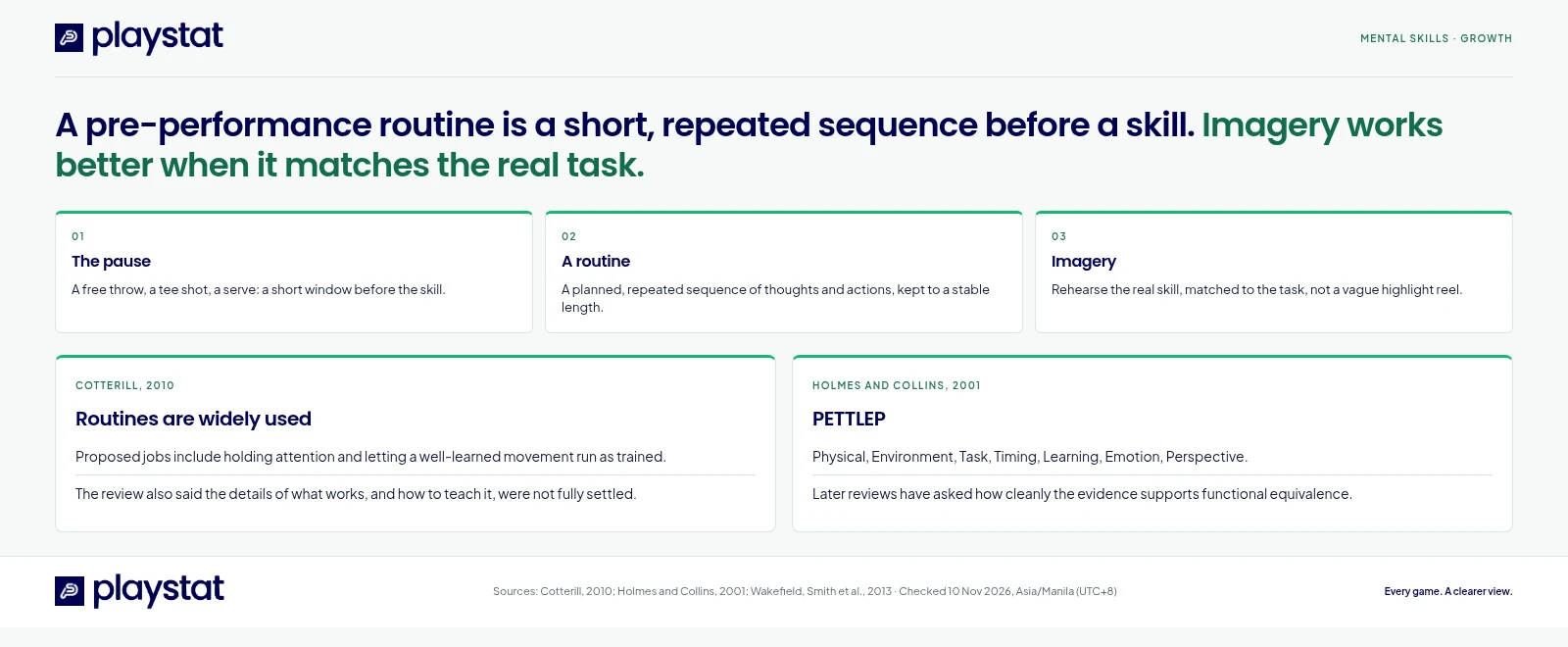
Sport psychology treats that pattern as a pre-performance routine, a planned sequence of thoughts and actions that comes before the skill is executed. Cotterill's 2010 review in International Review of Sport and Exercise Psychology is one of the standard surveys of that literature.[1] The review is useful as much for its caution as for its enthusiasm. Routines are widely used, and researchers have proposed several jobs for them, including holding attention, reducing distraction, and helping a well-learned movement run as it was trained. The same review makes clear that the functions, the exact ingredients, and the best way to teach a routine were not, at that point, fully settled.
That is a better starting point than a slogan about "getting in the zone." A routine is not magic, and it is not a personality test. It is a short, repeatable procedure attached to a skill you can practice.
If you already have a routine, the research question is whether it is doing a job: same length, same steps, useful under pressure, or just a superstition that grew extra movements over time. A routine that gets longer every month is often a sign of anxiety, not of better preparation. It is a practical warning that appears often enough in this literature to be worth saying plainly.
Imagery that tries to match the skill
Mental rehearsal is the other habit people attach to that pause. The risk is vagueness. "See yourself making it" is not much of a method.
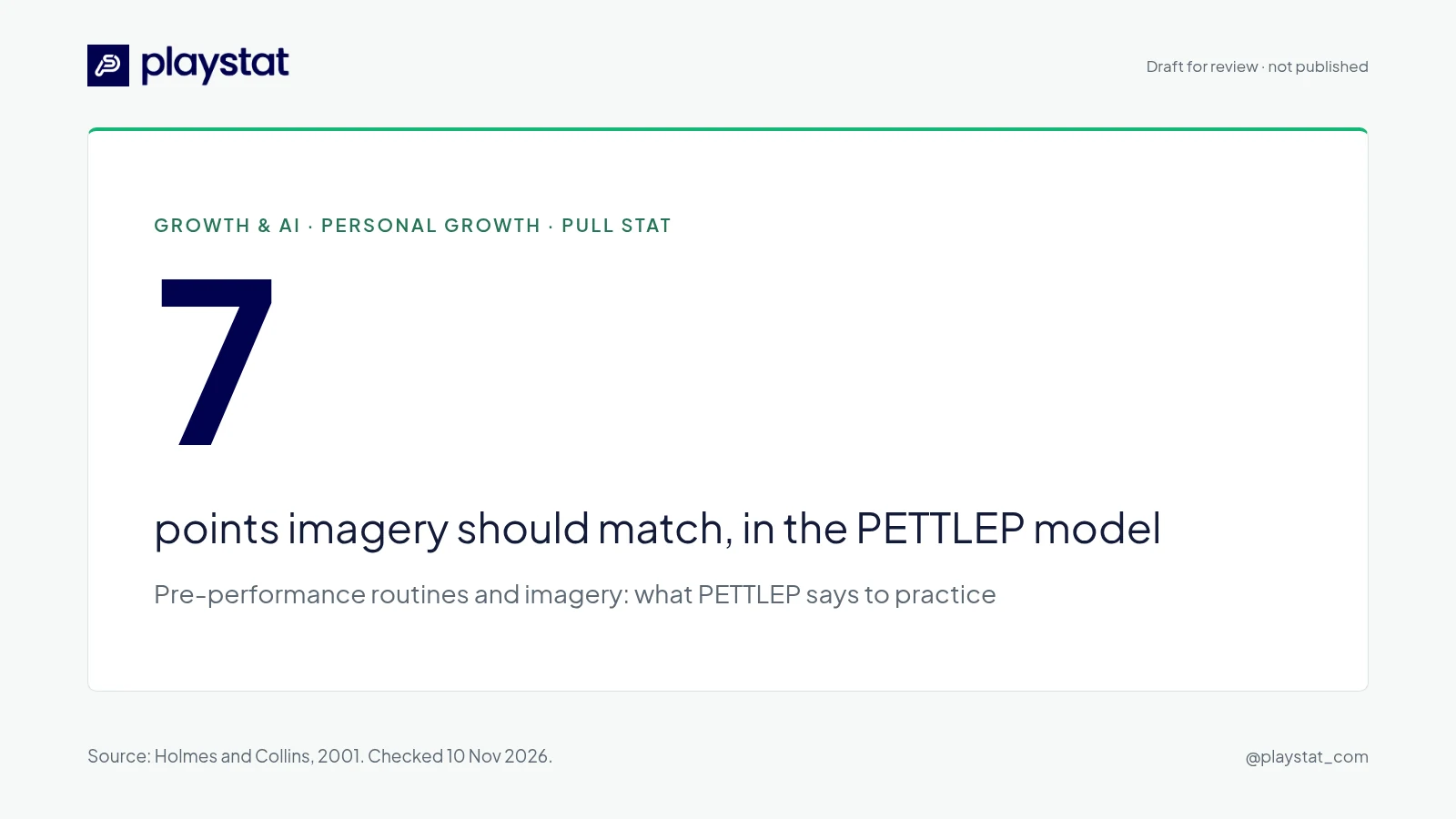
Holmes and Collins, in 2001, offered a more specific list.[4] Their PETTLEP model says motor imagery should be matched to physical performance on seven points: Physical (including posture and clothing where they matter), Environment, Task, Timing, Learning (updated as the skill changes), Emotion, and Perspective (first person or third, chosen with care). The argument is that imagery shares some of the same representations as doing the skill, so a closer match should make the rehearsal more useful.
Later work has not treated that as a closed case. A critical reflection on 15 years of PETTLEP research, by Wakefield, Smith, and colleagues, asked whether the evidence showed functional equivalence as neatly as the original model hoped, and what practitioners should actually do with the seven letters.[3] It uses the model as a checklist, and it notes that the evidence has been reviewed and debated.
A practical translation is still possible without overselling it. If you are going to rehearse a free throw, rehearse that free throw: the stance, the rim, the timing of the shot, the feeling of a miss as well as a make, at the speed you shoot. Do not run a slow-motion movie of a championship you have not played.
Try this
Write down a short pre-shot or pre-play sequence for one skill you already practice. Keep it under a few steps, and keep the length stable. Then, if you use imagery, run the PETTLEP checklist once: are you in the stance, in a comparable setting, doing the actual task, at real speed, with the emotion that comes with it, from a perspective you can hold? If the answer to most of those is no, tighten the rehearsal before you add minutes.
The money side
No sourced figure for sport-psychology staffing, session fees, or national-program spending was located in the papers reviewed.
References
Numbered markers in the text, such as [1], link to the source below. All links accessed 10 Nov 2026.
- Pre-performance routines in sport: current understanding and future directions. doi.org/10.1080/1750984X.2010.488269. Accessed 10 Nov 2026.
- The PETTLEP Approach to Motor Imagery: A Functional Equivalence Model for Sport Psychologists. doi.org/10.1080/10413200109339004. Accessed 10 Nov 2026.Used for: Physical, Environment, Task, Timing, Learning, Emotion, Perspective
- Functional equivalence or behavioural matching? A critical reflection on 15 years of research using the PETTLEP model of motor imagery. doi.org/10.1080/1750984X.2012.724437. Accessed 10 Nov 2026.
- Journal of Applied Sport Psychology record for Holmes and Collins, 2001. Taylor & Francis. tandfonline.com/doi/abs/10.1080/10413200109339004. Accessed 10 Nov 2026.