

Quick version
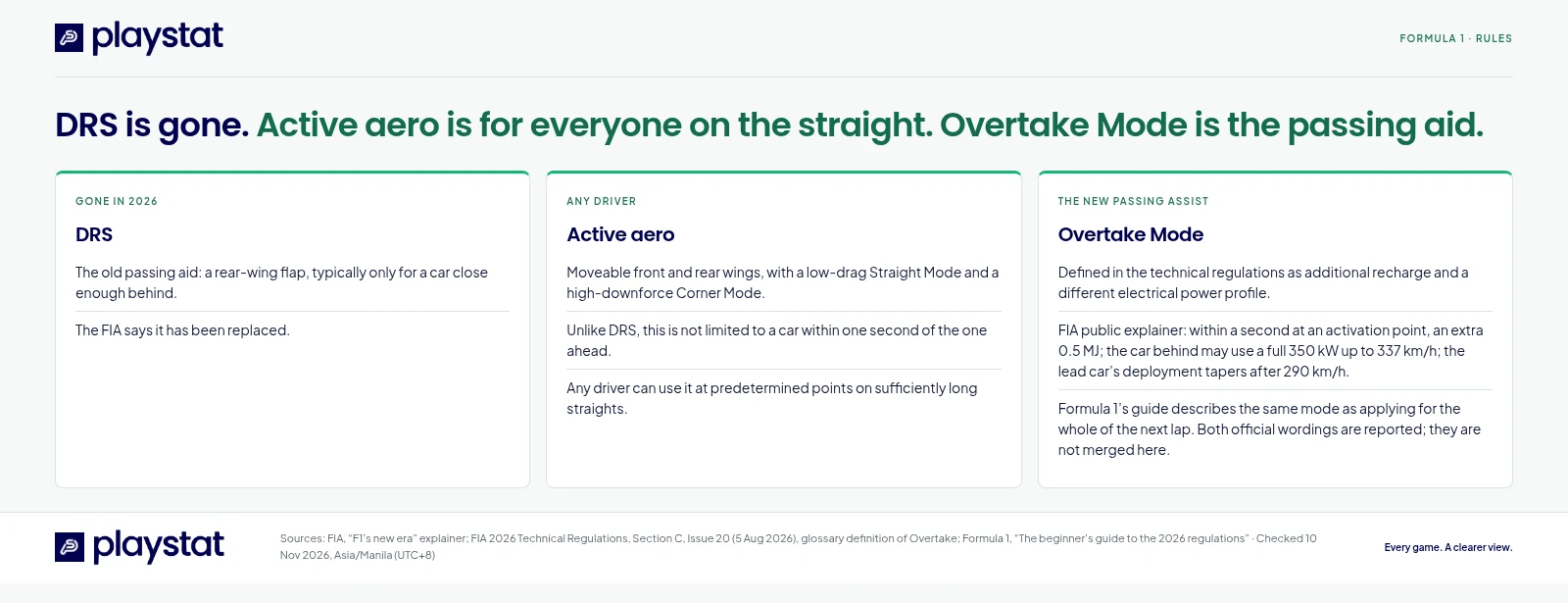
- An official FIA explainer for the 2026 regulations says the Drag Reduction System "is no more," replaced by moveable front and rear wings that switch between Straight Mode (flaps open, less drag) and Corner Mode (high downforce).[1]
- Unlike DRS, that active-aero system can be used by any driver at predetermined points on sufficiently long straights, regardless of gap to the car ahead.
- Overtake Mode is the new passing assist. The FIA's technical regulations define it as a mode that, when activated, "allows additional Recharge and an alternative ERS-K maximum power profile."[2]
What happened to DRS
For 15 seasons, a following driver who got within one second of the car ahead could open the rear wing in a marked zone and cut drag. The FIA's 2026 explainer draws a clean line under that: "For 2026, that Drag Reduction System (DRS) is no more, replaced by moveable front and rear wings that allow drivers to switch between two distinct modes."[1]
In Straight Mode, the front and rear wing flaps open to reduce drag. In Corner Mode, those flaps return to the high-downforce position. The important change is who gets to use the low-drag setting. "Unlike DRS, which was only available to drivers running within one second of the car ahead and in specific zones, the new active aero system can be activated by any driver at predetermined points on the circuit (straights of a minimum length) regardless of their position relative to other cars."
Formula 1's own beginner's guide to the 2026 regulations makes the same point more bluntly: the rear wing can still open, "but now everybody can do it." The FIA says the system is "primarily designed to help conserve energy," because the 2026 power units rely much more on electrical energy, and reducing drag on the straights is part of using that energy efficiently.[3] Overtaking, it adds, "will from 2026 be assisted in a different way."
What Overtake Mode actually is
The technical definition is in the 2026 FIA Formula 1 Technical Regulations, Issue 20, published Aug. 5, 2026, and approved by the World Motor Sport Council on Aug. 3.[2] In the glossary, "Overtake" is: "A mode, when activated and in accordance with the FIA F1 Regulations, that allows additional Recharge and an alternative ERS-K maximum power profile."[2]
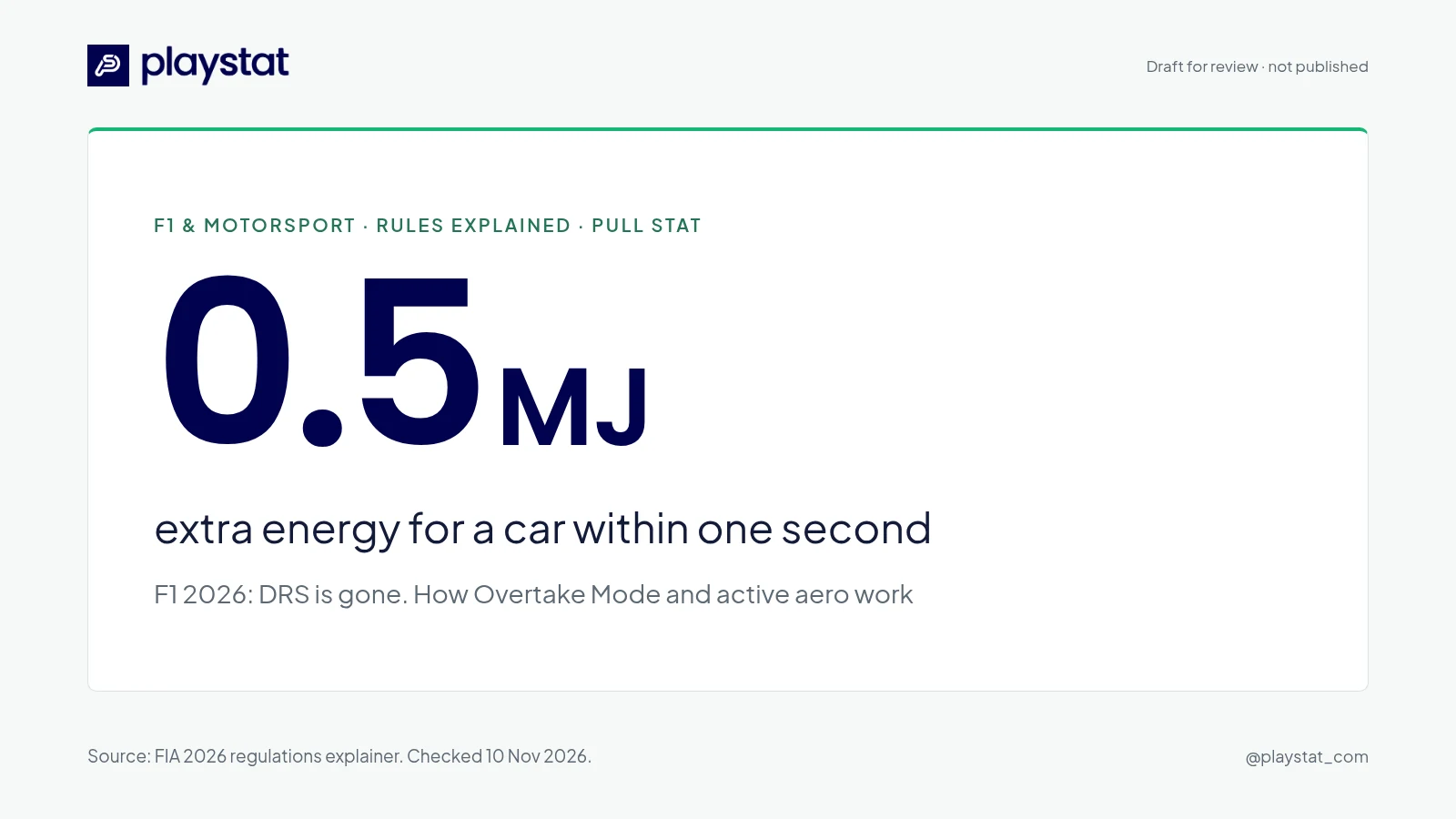
The FIA's public explainer fills in how that mode is supposed to be used as a passing tool.[1] "When drivers are within a second of the car in front at activation points, they will be able to deploy additional power energy to try to pass, with an extra +0.5MJ of extra energy available." It also describes an asymmetry at high speed: "The chances of an overtake occurring will also be increased by the leading car's energy deployment tapering off after 290km/h, while the car behind can use the override for a full 350kW up to 337km/h."
Formula 1's beginner's guide describes the same idea with a slightly different emphasis on duration: if a car gets within one second of the car it is chasing "at a designated point on the track, for the whole of the next lap it gets to use (and also harvest) a little more electrical power."[3]
The technical regulations also set different electrical power caps depending on whether Overtake is active, including a higher-speed power profile when it is. The detailed formulas are in Article C5.2.8 and are subject to the sporting conditions in Article B7.2.
Why the passing aid moved from the wing to the battery
The same FIA explainer places Overtake Mode in the new power-unit split.[1] The 2026 hybrid is still a 1.6-litre unit, but the FIA says internal-combustion power drops to 400 kW, while the battery element rises from 120 kW to 350 kW.[6] With more of the car's punch coming from electrical energy, the passing tool is an energy mode, not a rear-wing slot that only the car behind may open.
Active aero remains available to everyone on the designated straights. Overtake Mode is the part that still depends on being close enough, at the right point, to get the extra electrical allowance.
What that changes for a viewer
The old tell was visual and simple: a flap opened, and only if the gap was under a second. In 2026, open wings on a straight are not proof that someone is in a passing zone. They are the default low-drag setting. The passing advantage, when it is granted, is extra electrical energy for the car behind, under the conditions the FIA and Formula 1 have published.[1]
The money side
The 2026 cars are being built under two official spending limits, separate from the on-track passing rules. FIA Financial Regulations for teams, Section D, Issue 07 (25 June 2026), set the team Cost Cap at US $215,000,000, adjusted for indexation, when 24 or fewer competitions take place, with an extra US $1,800,000 for each competition above 24.[5] For teams that do not report in dollars, the same document gives an illustrative 2026 conversion, assuming 24 or fewer races, of 215,000 thousand US dollars to 170,090 thousand pounds sterling or 198,663 thousand euros.
A separate Power Unit Cost Cap, in Section E, Issue 1 (31 July 2025), is US $190,000,000, adjusted for indexation, in the inaugural-season year and each year after, and US $148,500,000, adjusted for indexation, in each of a manufacturer's N-3, N-2, and N-1 periods. The illustrative 2026 conversion for the $190 million cap is 152,918 thousand pounds sterling or 180,420 thousand euros.
Formula 1's own explainer (April 10, 2026) says the team cap rose from a 2025 base of $135 million plus inflation to $215 million, in part because costs that used to sit outside the cap, including depreciation, were brought inside it.[7]
References
Numbered markers in the text, such as [1], link to the source below. All links accessed 10 Nov 2026.
- F1's new era: Everything you need to know about how the FIA is making Formula 1 more competitive. fia.com/news/f1s-new-era-everything-you-need-know-about-how-fia-…. Accessed 10 Nov 2026.
- FIA Formula 1 Technical Regulations, Section C, Issue 20, dated 05/08/2026. fia.com/system/files/documents/fia_2026_f1_regulations_-_section…. Accessed 10 Nov 2026.Used for: glossary definition of "Overtake," and Article C5.2.8 power profiles
- The beginner's guide to the 2026 regulations. Formula1.com. Formula 1. formula1.com/en/latest/article/the-beginners-guide-to-the-2026-r…. Accessed 10 Nov 2026.
- FIA F1 2026 hub. fia.com/F126. Accessed 10 Nov 2026.
- FIA 2026 Formula 1 Financial Regulations (F1 Teams), Section D, Issue 07, 25 June 2026, Article D4.1.2. fia.com/system/files/documents/fia_2026_f1_regulations_-_section…. Accessed 10 Nov 2026.Used for: team Cost Cap US $215,000,000, adjusted for indexation; $1.8 million per competition above 24; illustrative 2026 conversions
- FIA Formula One Financial Regulations for Power Unit Manufacturers, Section E, Issue 1, 31 July 2025, Articles 2.3 and 2.4. fia.com/system/files/documents/fia_2026_f1_regulations_-_section…. Accessed 10 Nov 2026.Used for: PU Cost Cap US $190,000,000 / US $148,500,000, adjusted for indexation; illustrative 2026 conversions
- EXPLAINED: What is the F1 cost cap and why has it gone up?. Formula1.com, April 10, 2026. Formula 1. formula1.com/en/latest/article/explained-what-is-the-f1-cost-cap…. Accessed 10 Nov 2026.