

Quick version
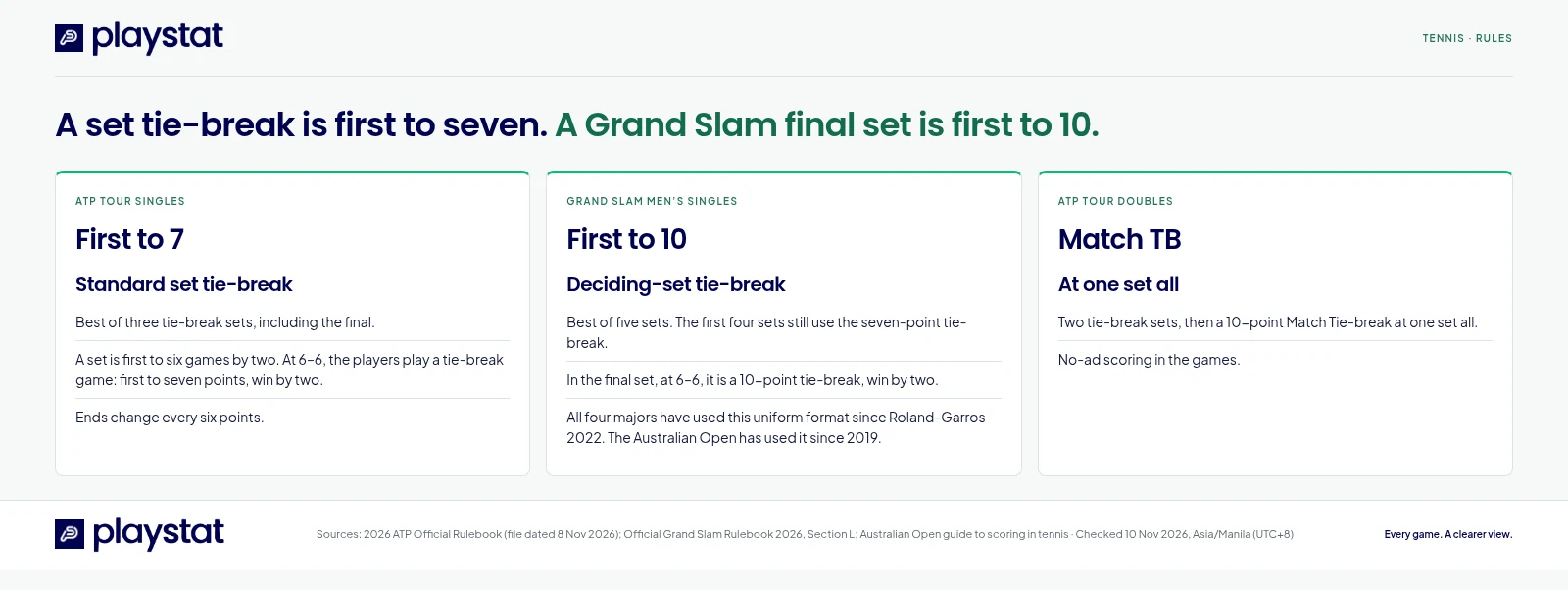
- The 2026 ATP Official Rulebook says all singles matches, including finals, are the best of three tie-break sets.[1] Doubles matches are two tie-break sets, then a 10-point Match Tie-break at one set all, with no-ad scoring.
- Under the Rules of Tennis printed in that same ATP book, a standard tie-break set is first to six games by two. At six games all, a tie-break game is played: first to seven points, win by two, with ends changed every six points.
- The official Grand Slam Rulebook for 2026 keeps men's singles main-draw matches at best of five sets, and says a 10-point tie-break is played in the final set.[2] The Australian Open's scoring guide says all four majors have used that uniform deciding-set format since Roland-Garros 2022.[3]
What "tie-break set" means on the ATP Tour
The ATP rule is short. In the circuit regulations, under "Matches – Number of Sets," singles is defined this way: "All matches, including finals, shall be the best of three (3) tie-break sets."
Doubles is a different sentence in the same article: "All matches, including finals, shall be two (2) tie-break sets with a deciding Match Tie-break (10 point) at one (1) set all. Games shall be decided using the No-Ad scoring method."
So a typical ATP singles match can end 2-0 or 2-1 in sets, and each of those sets, including a third set, is a tie-break set. A typical ATP doubles match does not play a conventional third set at all. At one set all, the players go straight to a 10-point match tie-break.
The standard tie-break, in the Rules of Tennis
The ATP book also reprints the Rules of Tennis. Those rules describe two main ways to score a set: an Advantage Set, and a Tie-break Set. For a Tie-break Set, "the first player/team to win six games wins that 'Set', provided there is a margin of two games over the opponent(s). If the score reaches six games all, a tie-break game shall be played."
The tie-break game itself is first to seven, win by two: "The first player/team to win seven points wins the 'Game' and 'Set', provided there is a margin of two points over the opponent(s). If necessary, the tie-break game shall continue until this margin is achieved."
Points are counted 0, 1, 2, 3, and so on, not 15-30-40. The player whose turn it is to serve starts the tie-break with one point, and service then alternates every two points. Players change ends after every six points.
That is the standard set tie-break you will see in an ATP Tour set that reaches 6-6, including a third set of singles.
What changes at a Grand Slam
Grand Slam events are not governed only by the ATP circuit regulations. The official Grand Slam Rulebook (2026) says the ITF Rules of Tennis apply unless the Grand Slam Board specifies otherwise, then draws its own line on set length:[2]
"All men's singles Main Draw matches in Grand Slam Tournaments shall be the best of five (5) sets. All other matches shall be the best of three (3) sets unless otherwise determined by each Grand Slam Tournament."
And on the tie-break: "The tie-breaks specified in the Rules of Tennis may be used in the Qualifying competition and the Main events, including the final set where a 10 point tie-break will be played."
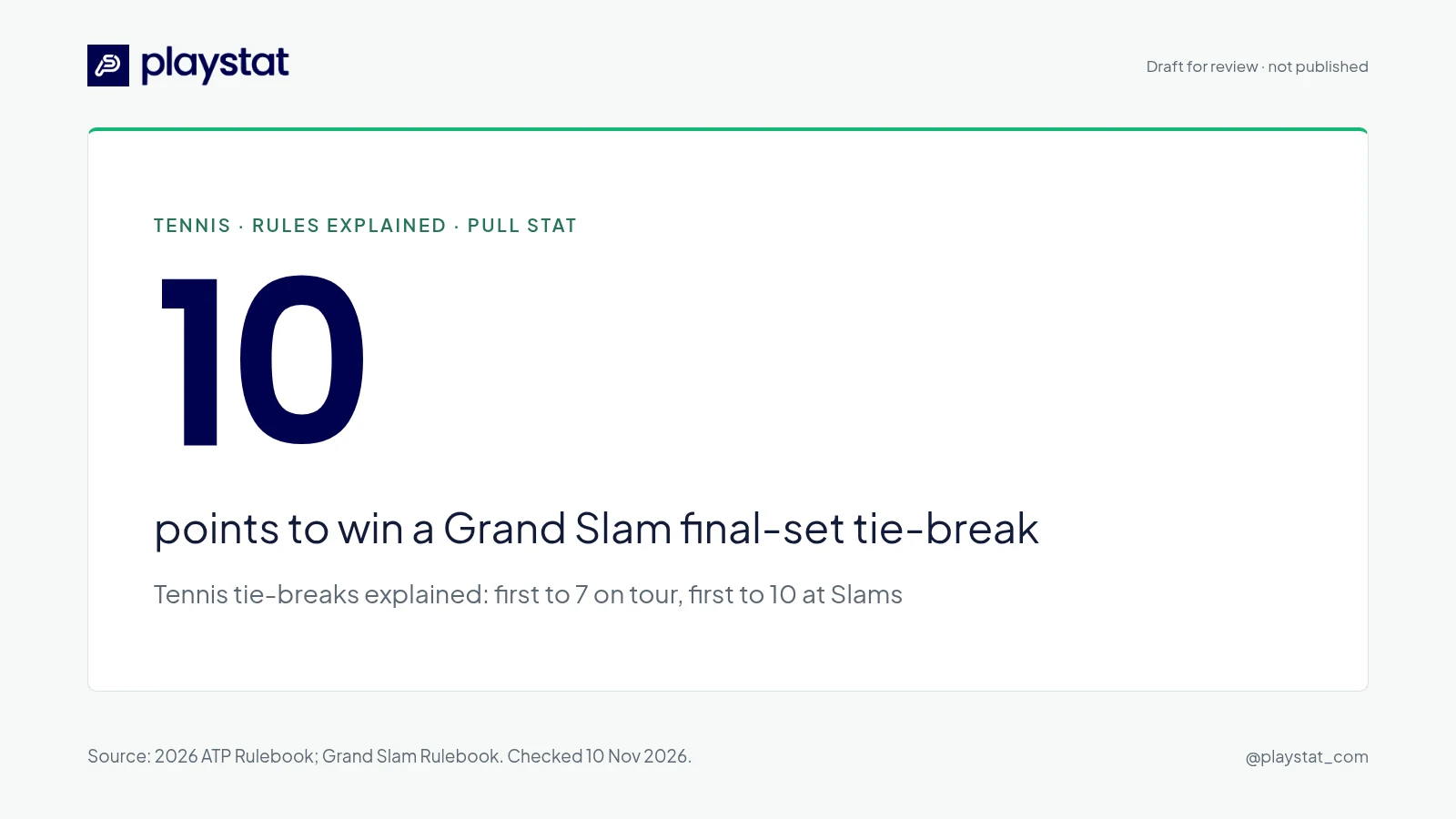
The Australian Open's official scoring guide fills in how that 10-point tie-break is actually won, and when the majors aligned.[3] A standard set still uses the seven-point tie-break at 6-6. In a deciding set — the fifth set of a men's singles match, or the third set of a women's singles match — the match tie-break is first to 10 points with a margin of two. Players still change ends every six points.
The same Australian Open guide says Melbourne first used a 10-point deciding-set tie-break at six games all in 2019, and that "all Grand Slams adopted a uniform scoring system in time for Roland Garros in 2022," ending the old advantage final sets in which a player had to win by two games after 6-6.[3]
That is the rule a viewer is watching in a fifth set at a major now: not an advantage set, and not the seven-point tie-break used in the earlier sets. It is a 10-point tie-break at 6-6.
The simple way to keep them straight
If it is an ATP Tour singles match, every set, including the third, is a standard tie-break set: 6-6, then first to seven by two. If it is ATP Tour doubles, the third set is replaced by a 10-point match tie-break. If it is a Grand Slam men's singles match, the first four sets use the standard seven-point tie-break, and the fifth set, at 6-6, is first to 10 by two.
The wording lives in two official books and in the Slam's own scoring guides. The numbers are not interchangeable.
The money side
The scoring change has a commercial backdrop that can be sourced at the majors, even if the ATP rulebook itself does not attach a dollar figure to a tie-break.[1] The Australian Open, which has used a 10-point deciding-set tie-break since 2019 and is one of the four Slams that standardized that format in 2022, announced a record $111.5 million prize pool for 2026, up 16 percent from $96.5 million in 2025.[4] Men's and women's singles winners are listed at $4.15 million each.
Tennis Australia's announcement states those figures in dollars without labeling the currency on the page.
References
Numbered markers in the text, such as [1], link to the source below. All links accessed 10 Nov 2026.
- The 2026 ATP Official Rulebook (file dated Nov. 8, 2026), circuit regulation on number of sets, and the reprinted Rules of Tennis on the tie-break set and tie-break game. ATP Tour. atptour.com/-/media/files/rulebook/2026/2026-rulebook_7nov26.pdf. Accessed 10 Nov 2026.
- Number of Sets, Tie-break. Official Grand Slam Rulebook 2026. world.tennis/media/5986/grand-slam-rulebook-2026-f2.pdf. Accessed 10 Nov 2026.
- A guide to scoring in tennis. Australian Open. ausopen.com/articles/news/guide-scoring-tennis. Accessed 10 Nov 2026.
- Australian Open announces record $111.5 million prize pool. ausopen.com/articles/news/australian-open-announces-record-1115-…. Accessed 10 Nov 2026.Used for: 2026 pool $111.5 million, up 16 percent from $96.5 million in 2025; singles winners $4.15 million