
Quick version
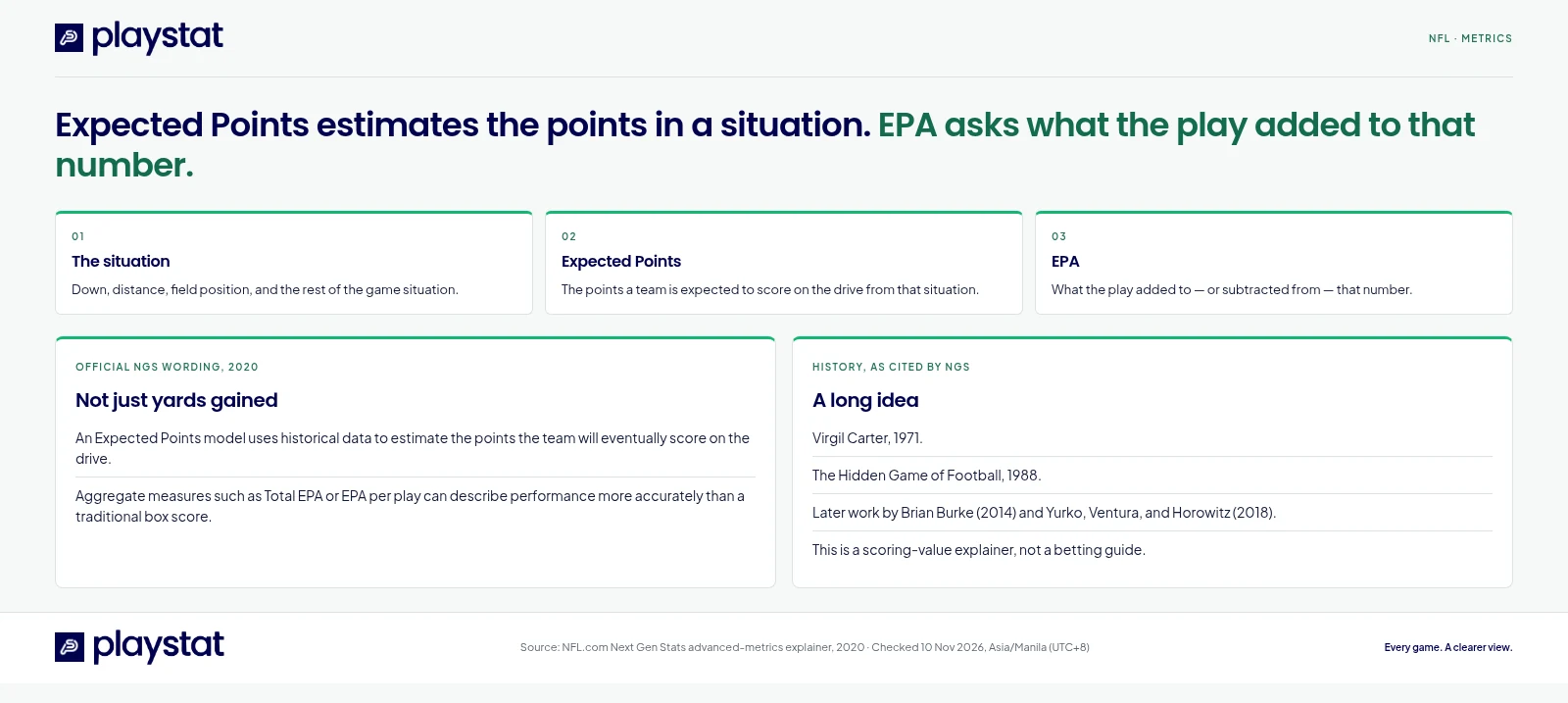
- Official NFL.com Next Gen Stats article, 2020: an Expected Points model uses historical data to determine the expected number of points the team will eventually score on the drive, given the current game situation.[1]
- Instead of quantifying a play’s success only by yards gained, the same article says, the success of a play can be estimated by Expected Points Added (EPA).
- Aggregate metrics such as Total EPA or EPA per play, in that official wording, can represent team or player performance more accurately than a traditional box score.
- The same article traces the idea to Virgil Carter in 1971, to The Hidden Game of Football in 1988, and to later work by Brian Burke in 2014 and Ron Yurko, Samuel Ventura, and Maksim Horowitz in 2018.
What Expected Points is measuring
The official Next Gen Stats article published on NFL.com in 2020 is the source for this explainer.[1] Before NGS finished a Live Win Probability model, it first built an Expected Points model. That model, in the league’s wording, uses historical data to determine the expected number of points the team will eventually score on the drive given the current game situation.
The point of the metric is comparison. Instead of judging a play only by the yards it gained, the article says, the success of a play can be estimated by Expected Points Added. EPA is the change in Expected Points from one snap to the next. A play that moves the team into a better scoring situation has a positive EPA. A play that makes the situation worse has a negative EPA.
The same official article says aggregate measures, such as Total EPA or EPA per play, can give a more accurate representation of team or player performance than the traditional box score. It also notes that “leading the league in passing” is often a shorthand for passing yards, and suggests Expected Points Added as a different way to describe passing value.
Where the idea comes from
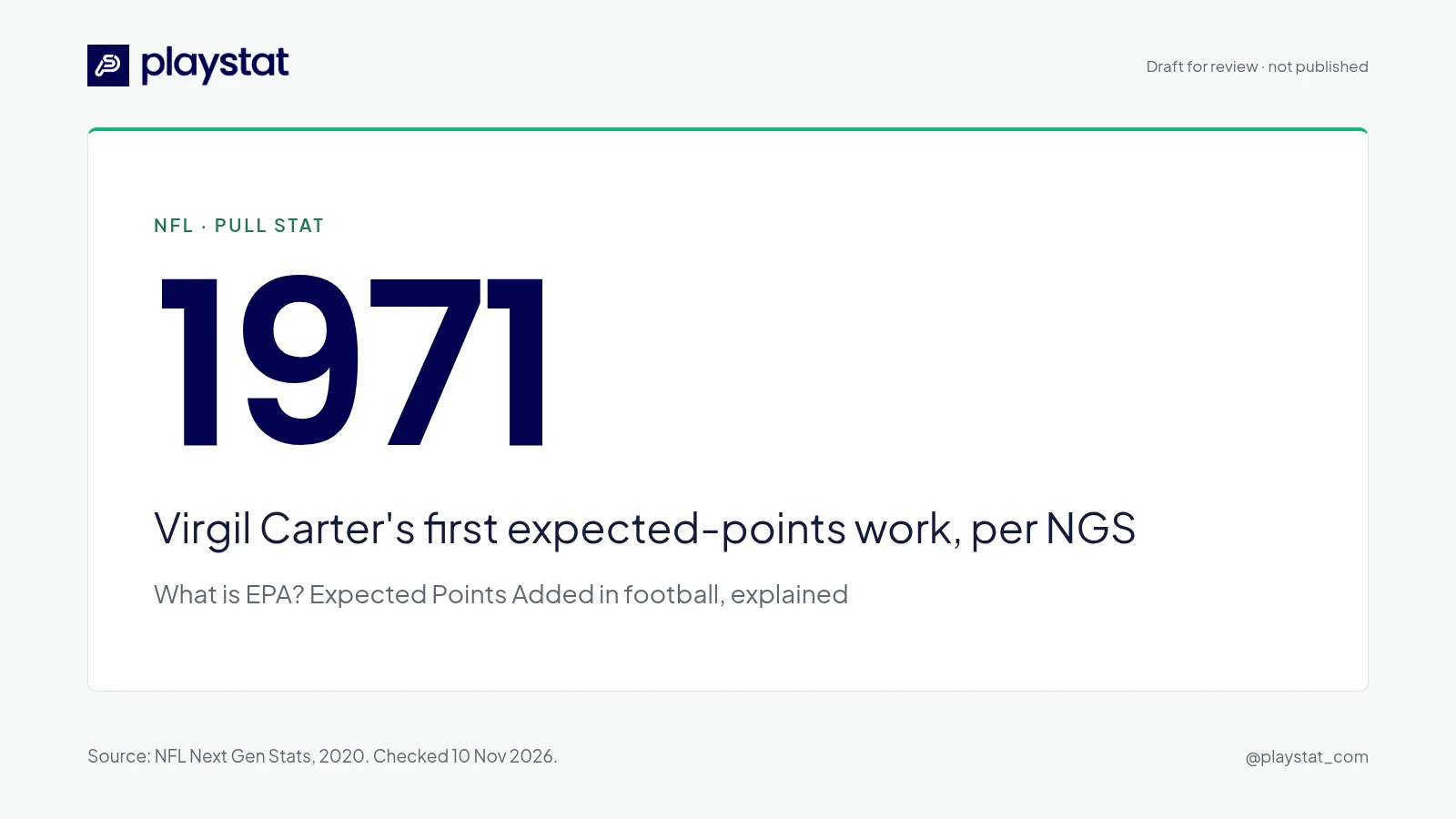
The official NGS article gives a short history. Expected Points was first introduced by former 49ers quarterback Virgil Carter in 1971, made popular by Bob Carroll, Pete Palmer, and John Thorn in 1988’s The Hidden Game of Football, and expanded upon by Brian Burke in 2014 and, most recently as of that 2020 article, by Ron Yurko, Samuel Ventura, and Maksim Horowitz in 2018.
The 2020 article also reported that, at the time it was written, the last four quarterbacks to lead the league in Total Expected Points Added in a single season had won the NFL Most Valuable Player Award in that same campaign, covering 2016 through 2019. That is a historical claim from the 2020 article. It is not restated here as a current, ongoing streak.
The money side
No sourced salary, contract, or award-dollar figure for EPA was located in the official 2020 NGS article reviewed.
References
Numbered markers in the text, such as [1], link to the source below. All links accessed 10 Nov 2026.
- Next Gen Stats: New advanced metrics you NEED to know for the 2020 NFL season. NFL.com. nfl.com/news/next-gen-stats-new-advanced-metrics-you-need-to-kno…. Accessed 10 Nov 2026.Used for: Expected Points as expected points on the drive given the situation; EPA as a play-success measure versus yards; history from Carter, The Hidden Game, Burke, and Yurko et al.; Total EPA / EPA per play